How homeschool grading works with us: every reading check and project is graded, and the grades become course grades, a GPA, and a transcript.
Who grades the work
In a homeschool the parent usually grades: writing a policy, scoring tests, building rubrics for essays, and averaging it all at the end of a term. The course includes grading. The saved work supplies the course grades that appear on the transcript.
That changes what grades are for. Your child learns what was right and what to fix in the same sitting, instead of a week later. And because every grade is recorded as it is earned, the course grades and the transcript are ready whenever someone asks for them.
Reading checks: ready for the next lesson
Progress checks throughout a lesson and a reading check at the end show whether the ideas have landed. They are part of the course, so your child can work toward the next lesson at their own pace.
A missed idea gets another chance. Your child can return to the reading, ask the mentor about the part that did not land, and try again. During a check, the mentor clarifies the ideas without pointing to an answer.
Projects: graded with written feedback
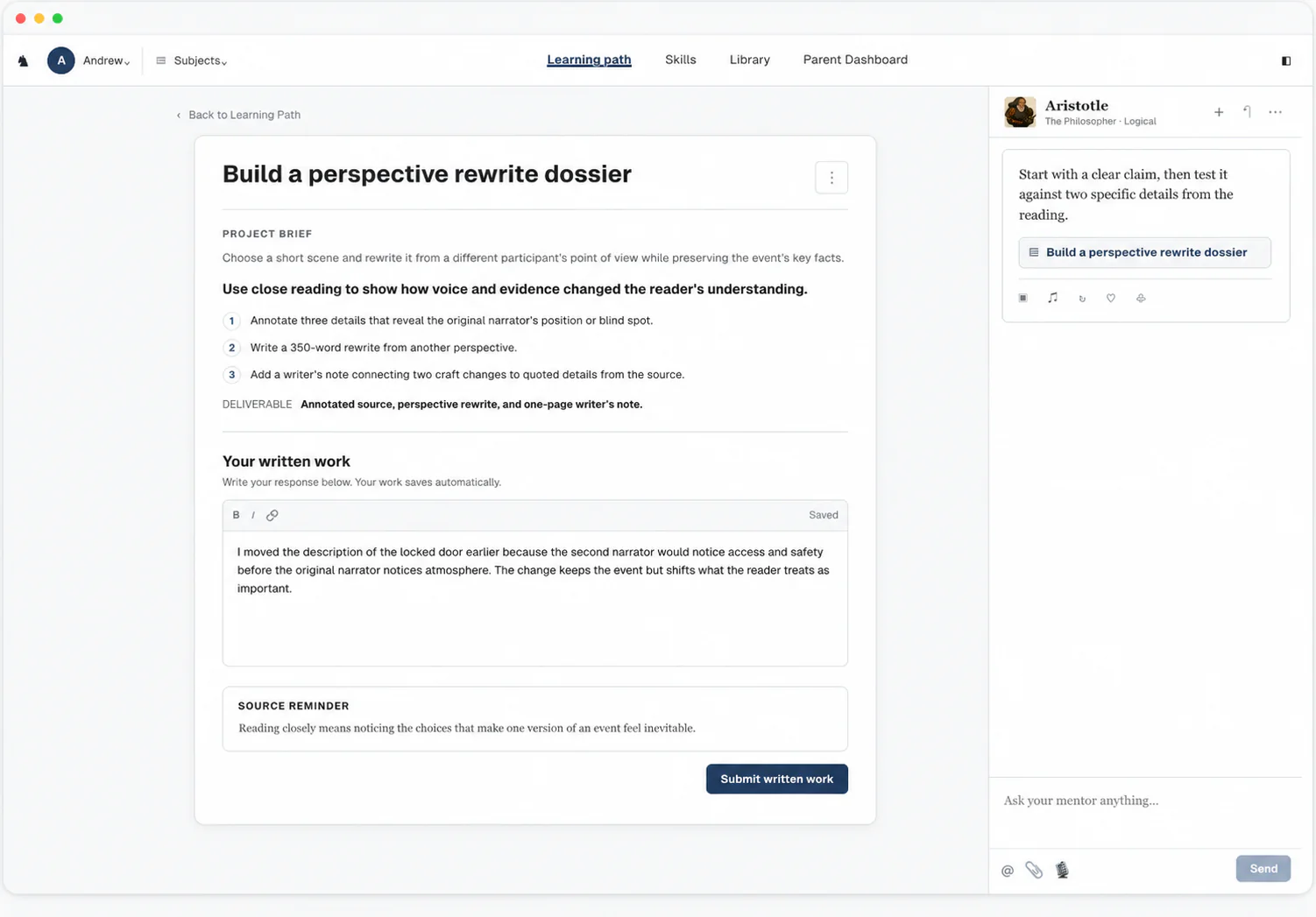
Each unit builds to projects, the longer work where your child applies what they learned: a written argument, a lab write-up, a design, a perspective rewrite in English. Every project has a brief that says what to make and what it will be judged on.
Project feedback describes strengths, areas to improve, and a next step. Your child can revise and resubmit, with earlier attempts kept so the grade has an inspectable history.
A project grade comes from the work your child submits. The Always-On Mentor can discuss a step during the project, but your child makes the decisions and writes the response.
Mastery and letter grades, both at once
Homeschool families often choose between mastery grading, where a child moves on only after showing a skill, and letter grades, which average the work over a term. The course gives your child both, and each does a different job.
Mastery decides the path. Your child moves forward by showing the skills in each subject, with review along the way to revisit earlier ideas. The skill map shows progress across the course, so completing a page never substitutes for understanding it.
Letter grades come from the graded work. A course's grade is the average of its graded work, turned into a letter with pluses and minuses. That is the grade a transcript, an evaluator, or a college reads.
What you see
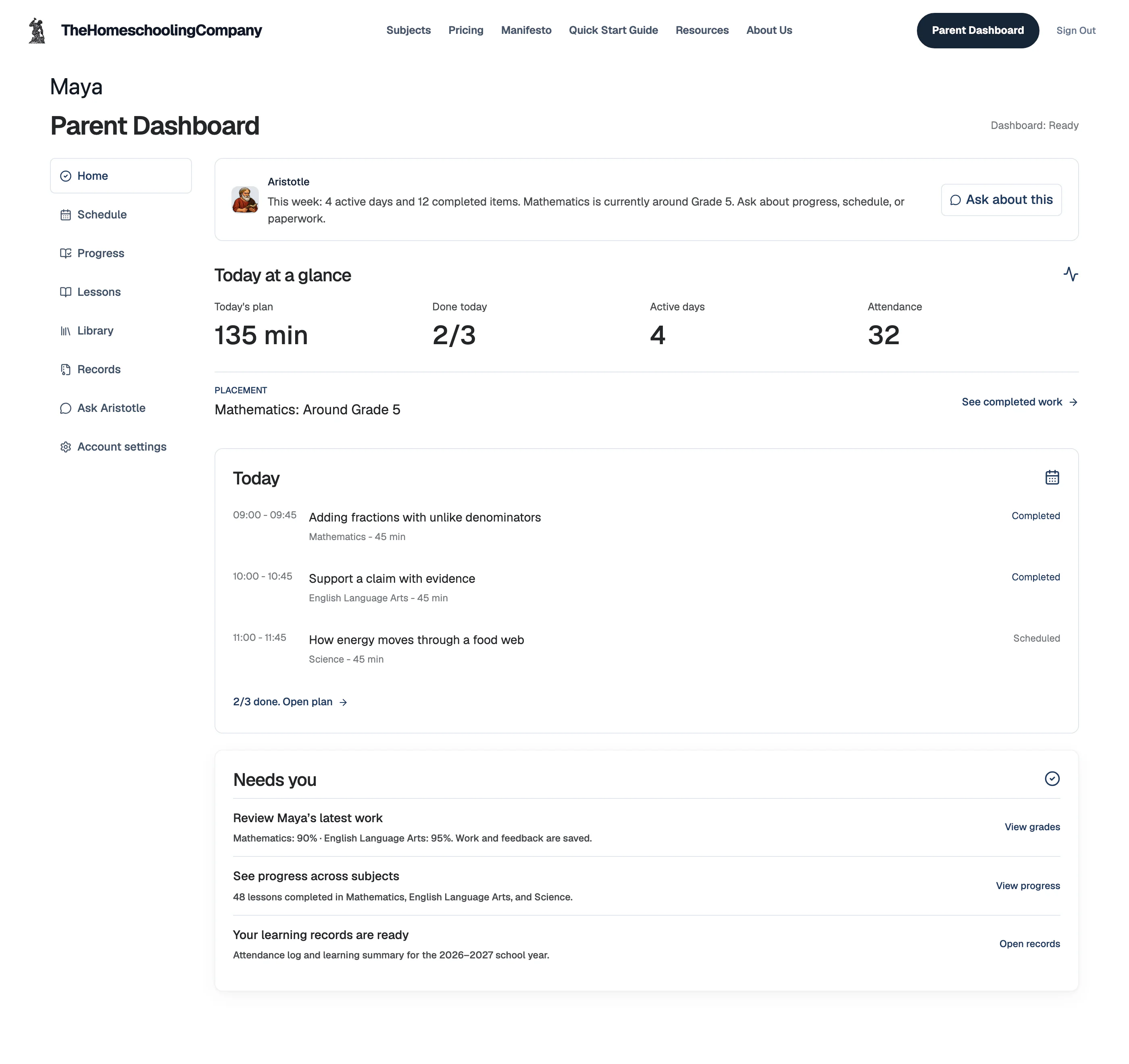
Our Parent Dashboard shows grades with their feedback, today's work, attendance, and progress in every subject. The saved assignments sit behind the summary, so you can see what each result came from.
You do not need to check anything for the grades to count. If something needs you, it appears in a short list called Needs you, such as records that are ready or a moment when your child asked the mentor for an answer.
Does your state need grades before high school?
Most states do not ask a homeschool for grades in the elementary and middle years. What some states ask for is evidence of progress. Florida requires a yearly evaluation. Pennsylvania wants a portfolio reviewed by an evaluator each year. New York asks for four quarterly reports and a yearly assessment. Our requirements checker shows your state's rule.
Because every piece of work is already graded and saved, those requests are answered from the record. In the document tools, you can generate a portfolio, a quarterly report, or an annual evaluation form, filled in from your child's work and ready for your signature or for the evaluator.
From course grades to a GPA
In high school, grades go on the transcript we generate. Each course gets one line per school year, with its credits and its letter grade.
Credits come from the hours your teen spent in the subject, which we estimate from the lessons they completed: 120 hours is one credit, and a subject with fewer than 15 hours in a year shows no credit yet.
The GPA is calculated the way colleges calculate it, weighted by credits. Each letter is worth points: A is 4, B is 3, C is 2, D is 1, and F is 0, with pluses and minuses counted at their letter's points.
Each course's points are multiplied by its credits, then the total is divided by all the credits, so a full-year course counts twice as much as a half-credit one.
- English, A, 1 credit: 4 × 1 = 4 points.
- Math, B, 1 credit: 3 × 1 = 3 points.
- Art, A, half a credit: 4 × 0.5 = 2 points.
- Total: 9 points over 2.5 credits, a 3.6 GPA.
The transcript prints two GPAs. The unweighted GPA uses the points above. The weighted GPA adds one point for each passing grade in one of our advanced courses, built on the College Board's AP course frameworks, so an A in an advanced course counts as 5. Colleges see both.
What makes a homeschool grade trusted
Admissions offices know a parent signs a homeschool transcript, so they read it beside other evidence. Grades that come from consistent, recorded work help, and so do the documents behind them: our course descriptions list, for each course, the lessons completed, the hours, and the topics covered.
Outside scores carry the most weight, because they let a reader check that an A means what a school's A means. An SAT or ACT score, an AP exam score, or a grade from a dual enrollment course on a college's transcript all do that.
Work your teen took somewhere else stays on that institution's transcript, and colleges read it alongside ours.
Athletes have one more step. For Division I or II, the NCAA asks the parent to sign a homeschool administrator statement and to complete a core-course worksheet for each core course. Division I requires a 2.3 GPA in core courses and Division II a 2.2. Our college admissions guide covers the rest of the application.
Frequently asked questions
- Can a parent give grades on a homeschool transcript?
- Yes. A homeschool transcript is issued by your homeschool, and colleges accept it. The grades on it come from your child's graded work, and you sign it as the homeschool's administrator.
- Are physical education and art graded?
- Yes. Physical fitness, health, and the arts are courses like any other, with readings, reading checks, and projects, so they earn grades and credits the same way.
- Do colleges recalculate homeschool GPAs?
- Some do, under their own rules. Our transcript prints its grading scale and both GPAs, so a college can convert each grade itself.
See your child's first grades this week
Open the first finished assignment and see what your child understood and what they can work on next.
$149/month per child after the trial.