Most states require no homeschool test. Learn the main testing patterns, which tests and evaluations count, what scores mean, and how our records support each one.
Check the requirement before choosing a test
First check whether your state requires a test or evaluation for the way you homeschool. Then check the grades or ages covered, the allowed tests, who may administer them, the deadline, and where results must be kept or sent.
The requirements checker shows your state’s rules. A publisher’s statement that a test is nationally normed does not by itself tell you whether it meets that rule.
If your state accepts a review of work, you may be able to use the portfolio you have kept through the year instead of booking a test.
How a testing state works: North Carolina
North Carolina is a typical testing state. Every homeschooled student takes a nationally standardized achievement test each school year, starting in the year the homeschool opens, and the test must cover at least English grammar, reading, spelling, and mathematics.
The state sets no minimum score and does not collect the results. The family keeps them at home for at least one year and shows them to the state's Division of Non-Public Education only if it asks.
The division names examples of tests families use, including the California Achievement Test (CAT 6), the Iowa Test of Basic Skills, the Stanford Achievement Test, TerraNova NEXT, Woodcock-Johnson, and the Classic Learning Test (CLT), and it also accepts the SAT, PSAT, ACT, and PreACT.
Choose a test your family can arrange
Among tests your state accepts, compare the format and who must give it. The North Carolina testing directory links to providers and their administration options; those options still need to meet your own state’s rules.
| If you want | Options to compare | Before booking |
|---|---|---|
| Paper or online testing | Iowa Assessments providers offer both formats; Stanford 10 providers list online, test-center, and at-home booklets. | Confirm your child’s grade is covered and that the administrator meets the test and state rules. |
| An evaluator to work with your child | Woodcock-Johnson providers offer administered testing, sometimes with a consultation. | Ask which achievement tests and reports the appointment includes. |
How a choice works: Florida
Florida requires an annual evaluation but no particular test. Each year the parent picks one of five ways to document the child's progress and files the result with the county's district school superintendent:
- A Florida-certified teacher the parent chooses reviews the child's portfolio and discusses the year's work with the child
- Any nationally normed achievement test, given by a certified teacher
- The state assessment the district uses, given by a certified teacher at a place and under conditions the district approves
- An evaluation by a licensed psychologist
- Any other valid measure the superintendent and the parent agree on
The portfolio behind the first option is the family's own record: a log of activities kept as the teaching happens, naming the reading materials, plus samples of the child's writing, worksheets, and other work.
Our document tools organize saved coursework and prepare a draft; the qualified reviewer makes the evaluation. Other states set their own reviewer qualifications and decide whether the result stays at home or must be submitted. The requirements checker explains your state’s process.
Which tests count, and who can give them
States that test ask for a nationally normed achievement test, which compares your child's score with a national sample of students in the same grade. Oregon and Washington use lists approved by their state boards.
Some states let your child take the state's own test at a public school for free. Pennsylvania districts must offer the statewide test, Hawaii offers its state tests at your local school, and Tennessee allows its state test at your zoned school in grades 5 and 7.
Florida districts must make the statewide assessments they give available to home education students and tell them the dates, places, and deadlines.
Who gives the test depends on your state's rule and the test's own instructions. North Carolina lets a parent give a test when the publisher allows it.
Florida requires a certified teacher for both of its test options, Pennsylvania does not allow a parent to give the test, and Oregon and Tennessee require a tester or proctor who is not related to your child.
What scores mean, and what follows a low one
In most testing states, a test is evidence, not a pass or fail. North Carolina sets no passing score, so a low result has no legal consequence there. A low result has consequences elsewhere:
- New York: a composite score above the 33rd percentile, or one year of growth, meets the standard.
- Virginia: a composite at or above the 23rd percentile, or an evaluation the superintendent accepts, is due by August 1; without that evidence, the program can be placed on a year of probation.
- Minnesota: a total score at or below the 30th percentile leads to a further evaluation for learning problems.
- Oregon: a score below the 15th percentile means a retest within a year.
- Colorado: at or below the 13th percentile, your child retests; if the result stays there, the district requires school enrollment.
Florida acts on progress that is not in line with the child's ability. The superintendent notifies the parent in writing, the family has one year from that notice to provide remedial instruction, and the child is evaluated again at the end of it. Continuing to homeschool depends on that second evaluation showing progress.
Tests that sit outside homeschool law
Some tests have nothing to do with your state's homeschool requirement, and a teen may still want them. Some states let one test serve both purposes: Virginia accepts an SAT, ACT, or PSAT score as evidence of progress, and North Carolina accepts those tests and the PreACT for its annual requirement.
- The SAT or ACT, for college applications. Your teen registers online and tests at a test center; on the SAT form, homeschoolers enter the high school code 970000.
- The PSAT/NMSQT, which is given at schools. A homeschooler contacts a participating school at least four weeks before its testing window and tests as a visitor. In Texas, a district that gives the PSAT or AP exams to its own students must let homeschoolers take them and must publish the dates and how to register.
- AP exams, taken at a local school that offers them, through its AP coordinator.
- College placement tests for dual enrollment, which the college sets. Texas public colleges, for example, use the TSIA2 unless a student's SAT or ACT scores exempt them.
- Sports eligibility tests. Texas asks homeschool athletes for an average or higher score on a nationally recognized norm-referenced test.
Use the year’s work to prepare and document progress
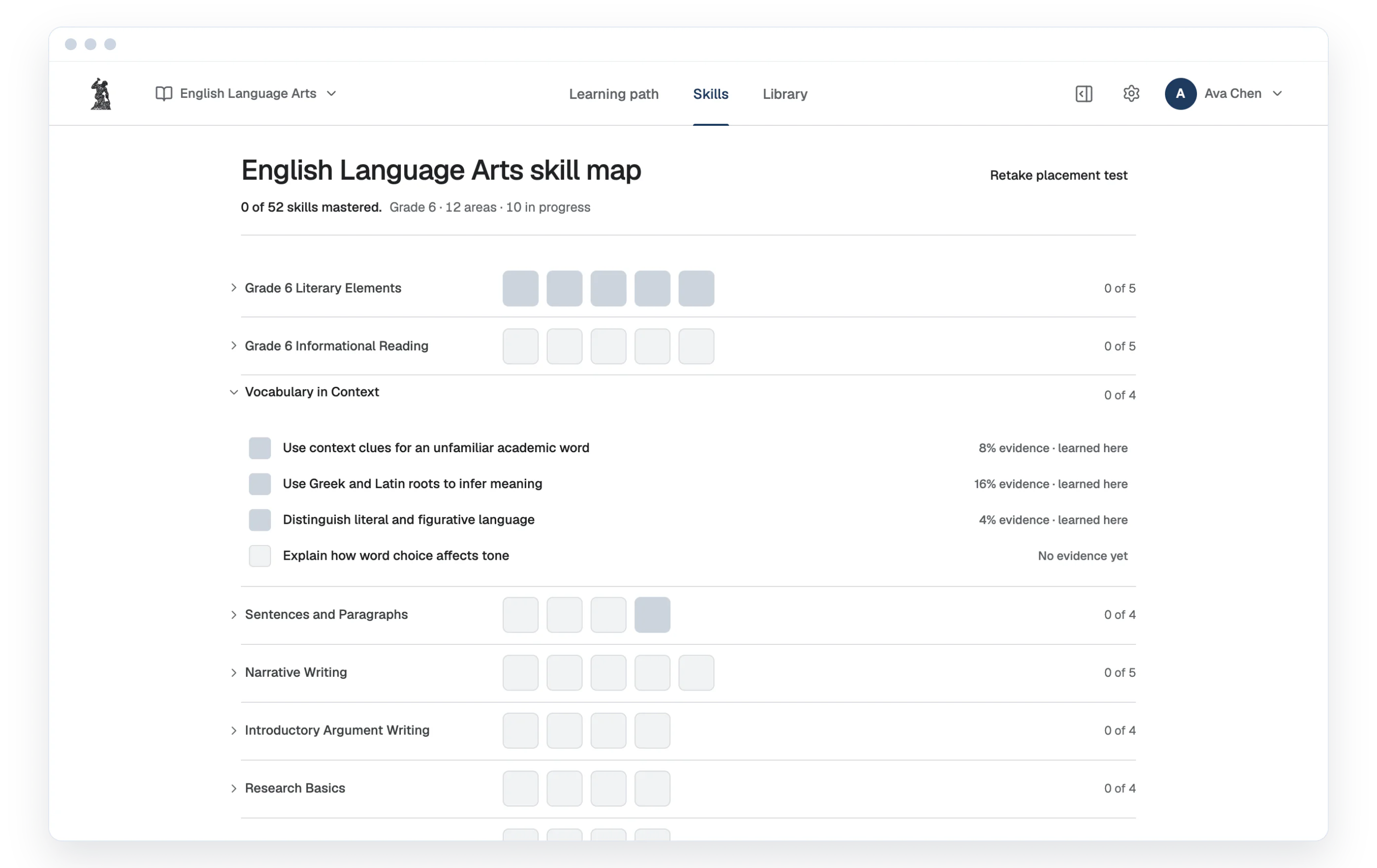
The skill map shows evidence by skill, and completed work stays saved with grades and feedback. Those records can help you notice a topic needing practice before a testing date or select work for an evaluator to review.
The document tools can draft a test-results page, evaluation record, narrative, or portfolio from the available record. You arrange the actual test or qualified evaluation under your state’s rules, then add the result to the year’s documents.
SAT Prep and ACT Prep are available as courses, and advanced courses include practice in their exam formats. Those are preparation options; your testing provider or host school handles registration and administration.
Frequently asked questions
- Does a test my child takes for college or sports count for the state?
- Only if your state allows that test or category of test. For example, a nationally normed achievement test may meet both requirements when it matches your state’s rules.
- Does the test have to cover every subject?
- No. Each state names its own subjects: North Carolina's test covers English grammar, reading, spelling, and math, and Pennsylvania tests reading and math.
- Are there alternatives for a child with a disability?
- Some states provide them. Oregon evaluates a child with an IEP the way the plan says. North Carolina exempts no one, but a child may take a test written for the level where they work, with any accommodations recorded.
A year of graded work behind every test
We save reading checks and projects with their grades and feedback throughout the year. You can bring that work to an evaluation or use it to understand which skills need attention after a test.
$149/month per child after the trial.
Sources (8)
- North Carolina Division of Non-Public Education: standardized testing
- Florida Statutes section 1002.41: home education program
- New York: 8 NYCRR 100.10, home instruction
- Code of Virginia section 22.1-254.1: home instruction
- Texas Education Agency: home schools letter
- Texas Higher Education Coordinating Board: Texas Success Initiative
- University Interscholastic League: homeschool FAQ
- College Board: homeschooler's guide to College Board tests