Your child can return to public school at any time. The district decides grade placement and high school credit; here is how states handle it and what to bring.
Your child can go back at any point, and what enrollment asks for
Families return to public school for all kinds of reasons: a parent's new job, a teen who wants a particular program or team, a move, or a simple preference for a classroom. It is not a sign the homeschool failed, and it does not have to wait for August.
Public schools enroll resident students during the year; the Texas Education Agency, for example, says home-schooled students can enter public school at any time.
Start with a call or email to your district's enrollment or registration office. Ask three things: what the district needs for enrollment, how it sets grade placement for students coming from homeschool, and, for a teen, its written policy on homeschool credit. Asking a few weeks ahead gives you time to gather what it wants.
Enrollment paperwork is set by each district, but most ask for the same core documents:
- Proof of age: a birth certificate or passport.
- Proof of residence: a lease, mortgage statement, or recent utility bill in your name.
- Immunization records, or the exemption your state allows.
- Your identification as parent or guardian, and any custody papers if they affect who can enroll your child.
- Academic records: whatever you have from earlier schools and from your homeschool.
Who decides grade placement
Below high school, placement is a decision about which grade your child joins, and the receiving school makes it. States describe the process differently:
- North Carolina: the principal decides, often from your child's latest standardized test results, and usually accepts those results without retesting if a parent or relative did not give or score the test.
- Idaho: the school may test your child, review homeschool coursework and records, or place your child provisionally in the grade for their age.
- Illinois: the school may test or ask for proof of the material covered, but its method may not be unreasonable or arbitrary, and it cannot require your homeschool to have registered with the state.
- Ohio: the district places your child in the appropriate grade without discrimination or prejudice, under its own policies.
Records help a school place your child where they are rather than by age alone, which matters most for a child who is ahead in some subjects.
High school credit: each state handles it differently
For a teen, the bigger question is which homeschool courses count toward a public school diploma. The receiving school decides, and the rules vary widely by state:
- Texas: a homeschool transfer is treated like a transfer from an unaccredited private school. The district may award credit by reviewing your teen's curriculum and work or by examination, and its passing standard can be no higher than the one for private school transfers.
- Pennsylvania: the school decides which credits to accept under its own policy, no law requires it to accept any, and it may ask for portfolios or an evaluation listing completed courses.
- New York: only schools award high school credit, and the state recommends that the principal grant it based on an assessment or evidence your teen completed the coursework.
- Illinois: the school may not grant credit for classes from an unaccredited program.
- Georgia: the local school system decides which homeschool courses earn units of credit, following State Board of Education rules and local policy.
Ask for the district's policy in writing before you enroll, especially for a junior or senior, and ask whether credit by examination is available for courses it will not accept on records alone.
The records we produce for the new school
Schools ask for evidence, and with us that evidence already exists. In our Parent Dashboard, the document tools generate each document from your child's work:
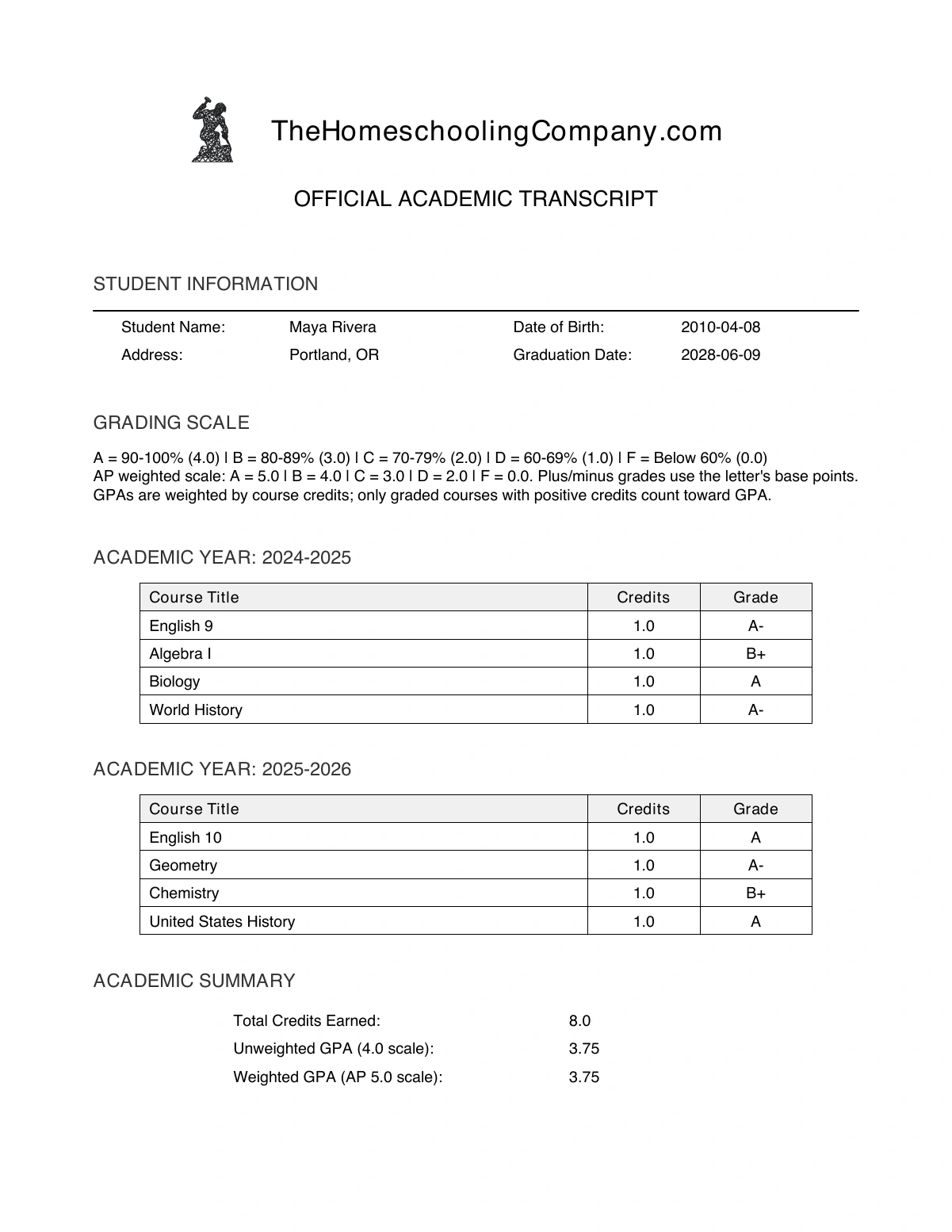
- Transcript: each school year's courses with credits and grades, total credits, unweighted and weighted GPA, and a signature line for you as the homeschool's administrator.
- Course descriptions: for each subject, the number of lessons, the recorded instructional hours, and the lesson topics, which is what a school reviewing credit usually wants.
- School profile: a description of your homeschool for the receiving school.
- Learning summary PDF and attendance PDF: the best records for a younger child, showing what they studied and the days and minutes of instruction.
Export records bundles everything, transcript included, into one ZIP file you can email to the registrar. Credits on our transcript come from the hours of completed lessons in each subject, at 120 hours a credit, so the numbers a school sees trace back to real work.
Special education when your child returns
Once your child enrolls, the school's special education duties apply to them as to any other student; federal law requires states to identify and evaluate every child with a disability who needs special education.
If you think your child may need services, ask the district in writing for an evaluation when you enroll, and include any earlier evaluations or IEP documents you have. A 504 plan or IEP from before your homeschool years is a useful starting point, but the district will usually want current information.
Tell the evaluator what has helped at home, such as having lessons read aloud or working in short blocks, so the plan starts from what your child already knows works.
Trying part-time first
Some families test the waters with one or two classes before a full return. Whether that is possible depends on the state:
- Pennsylvania: since the 2023-24 school year, districts must let home education students take academic courses for up to at least a quarter of the school day, plus activities and career and technical programs.
- Washington: districts must let homeschooled students enroll part time in courses and receive services such as counseling, testing, or speech therapy.
- Idaho: a homeschooled child can enroll part time in any public school, with full-time students getting priority in full programs.
- Illinois: request a class for the next school year before May 1, from a school in your own district, and it is granted if there is space.
- New York: part-time attendance is not authorized, apart from special education services.
A child returning to school can keep one course here on Single Subject, such as a subject the school does not offer. That course continues with its lessons, mentor help, grading, and record alongside the school’s own timetable.
Getting your child ready for the classroom
The academic move is usually the easy part; the routine is the adjustment. Two weeks before the first day, shift wake-up and bedtime to the school schedule. Talk through what will be new: bells, moving between rooms, homework every night, raising a hand, and timed tests.
If the school allows a visit or a meeting with a counselor before the first day, take it, and see whether your child can meet a teacher or a classmate ahead of time.
A few school skills may need practice that homeschooling did not give: copying notes from a board, finishing a test against the clock, and juggling assignments from several teachers at once. A week or two of practicing these at home, before the first day, makes the first month easier.
Frequently asked questions
- Do I tell the state my homeschool has ended?
- In some states, yes. Florida asks for a written termination notice, with that year's evaluation, within 30 days. North Carolina asks you to close the home school through its online portal.
- Can my teen still earn a public school diploma?
- Often, if the school accepts enough credits and your teen meets its graduation requirements while enrolled. Illinois, for example, requires full-time enrollment and every state graduation requirement for a public school diploma.
- Should I keep our homeschool records after my child goes back?
- Yes. A school, college, or state may ask for them later, and some states, such as Florida, require you to keep a portfolio for two years. Export records gives you a complete copy to keep.
Records ready before the first school meeting
Your child's transcript, course descriptions, and attendance are generated from their work, ready to send to the registrar.
$149/month per child after the trial.
Sources (10)
- Texas Education Agency: home schooling
- Texas Education Agency: home schools letter (2019)
- North Carolina Division of Non-Public Education: home to public school transition
- Idaho Department of Education: homeschooling FAQ
- Illinois State Board of Education: Illinois Homeschooling
- Pennsylvania Department of Education: Home Education and Private Tutoring
- New York State Education Department: special education for home-instructed students
- Washington RCW 28A.150.350: part-time students
- 34 CFR 300.111: child find
- Florida Statutes section 1002.41: home education programs