Homeschooling lets a teen athlete fit school around training and travel. Here is how the week works with us and what the NCAA and NAIA ask of homeschoolers.
What we do for a teen athlete
A serious athlete's week is built around practice, lifting, recovery, and travel, and a school bell does not bend to any of it. Homeschooling lets the schedule come first and school fill the hours that are left, without the school part getting thinner.
We run the school. We place your teen in each course, teach every lesson, help in the moment they are stuck, grade the work, count credits from the hours each course records, and generate the transcript, course descriptions, and diploma for you to sign. You do not need to plan lessons around the season or chase down grades between tournaments.
A week built around training
In our Parent Dashboard, the weekly schedule asks for the school days, a start time, daily minutes, and the length of each block and break, then fills the week with blocks that rotate through your teen's subjects.
A swimmer with 5 a.m. practice can start school at ten; a teen who trains after lunch can do the day's work in the morning.
Seasons are uneven, and the schedule can be too. Any block can be moved or edited, so a tournament week can be light and an off-season week heavy. Because each course moves at your teen's own pace, a light month never leaves them behind a class; the next lesson waits exactly where they stopped.
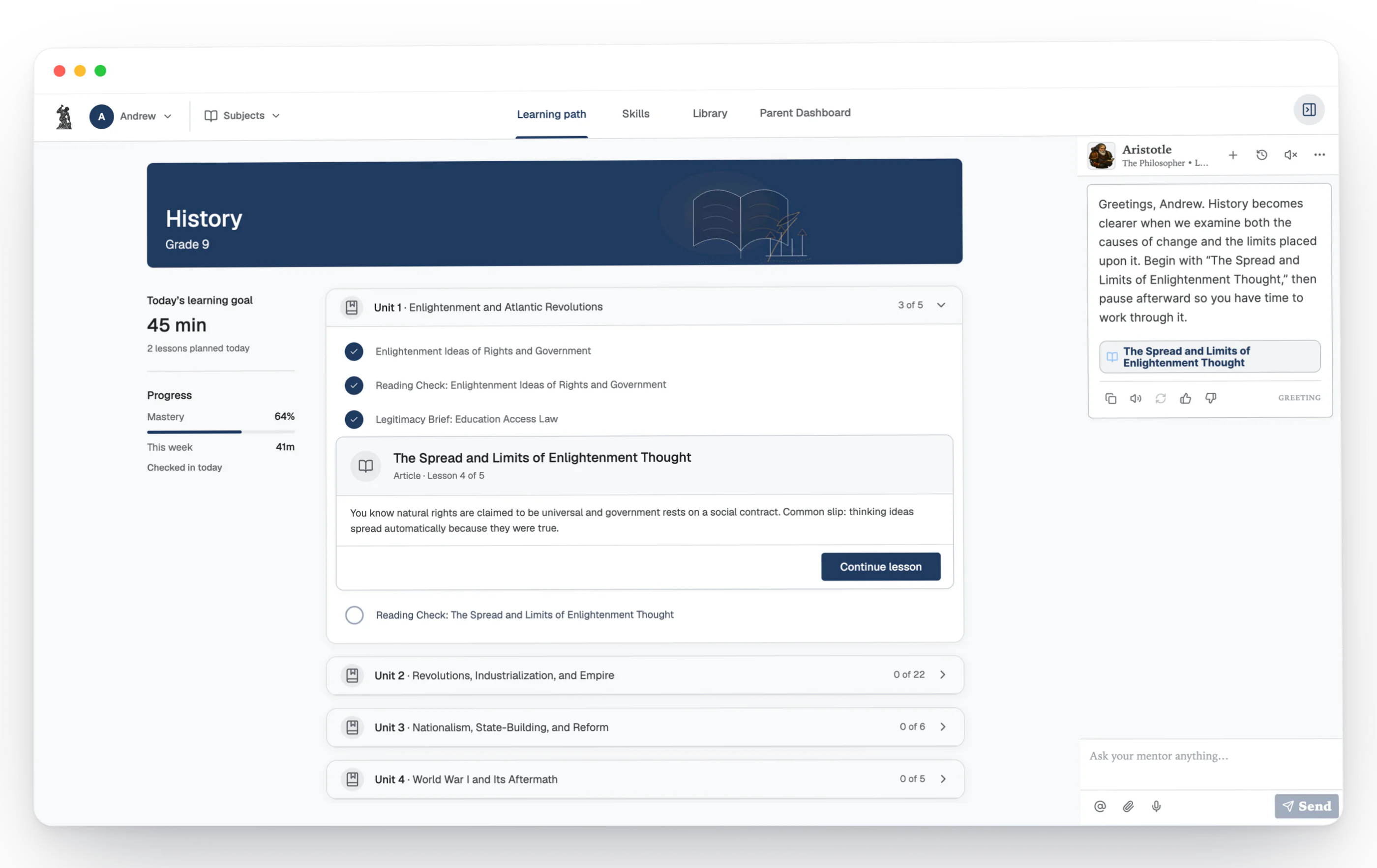
Your teen checks in once a day, and their activity keeps the session open, so attendance counts a day of lessons done on a bus, in a hotel, or at the kitchen table between sessions. On a travel day with poor signal, lessons and reading checks can be printed ahead for time offline.
Keep questions from waiting for the next free evening
Your athlete may be studying at an unusual hour after training or while traveling. The Always-On Mentor is inside the lesson, available to explain a passage, draw an idea, or help plan a next project step.
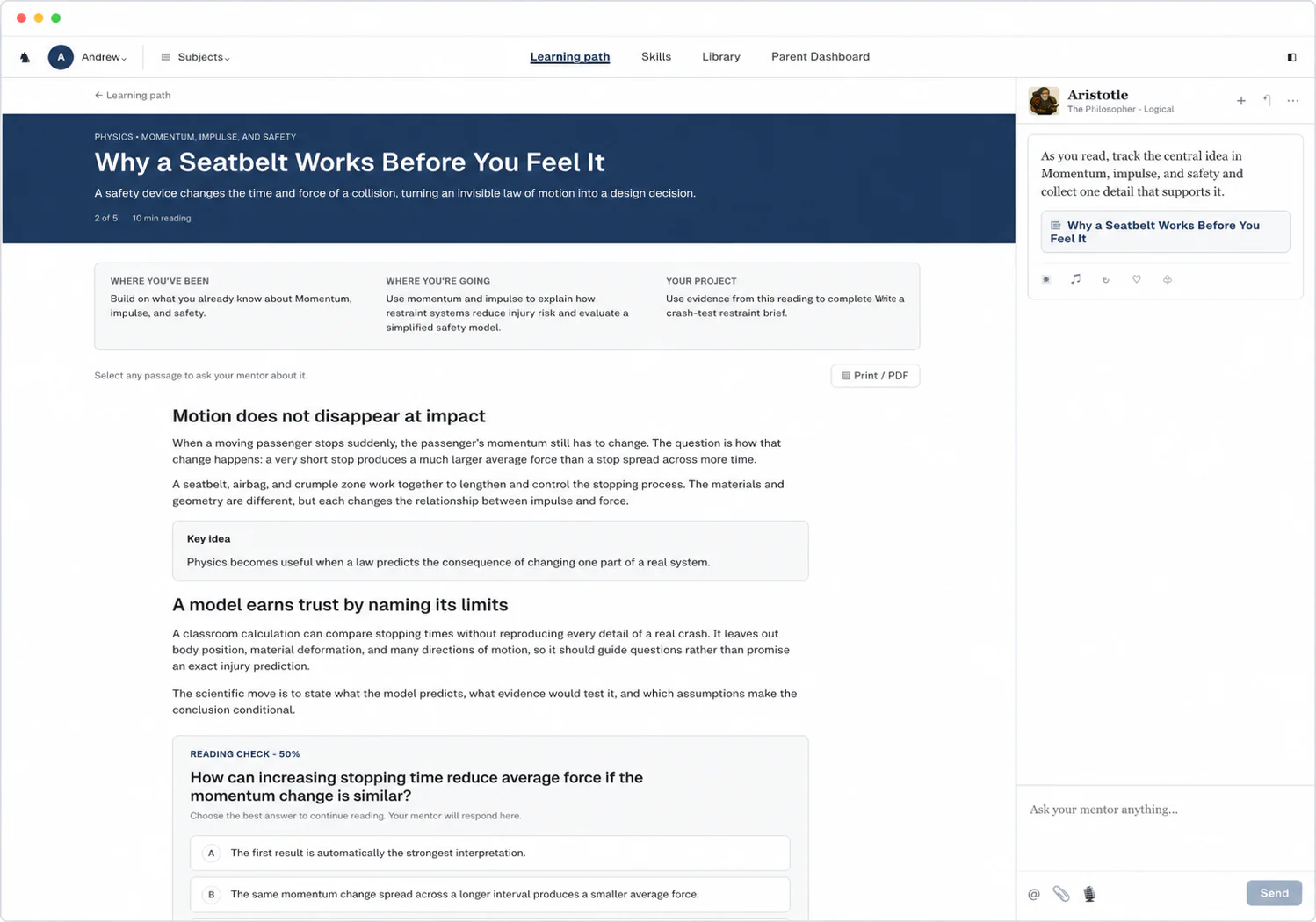
Independent checks still ask for your teen’s own answer. Grades and project feedback are saved with the submitted work, so you can review academic progress alongside the training plan.
The courses and the credits
Most high school athletes use School in a Box, our full plan of up to 12 subjects at once. It covers the four core subjects, math, English language arts, science, and history, with a catalog that runs from algebra, geometry, pre-calculus, calculus, and statistics to biology, chemistry, physics, Spanish, economics, and SAT and ACT prep. Physical fitness and health are courses too.
Credits come from the time each course actually took: we estimate each completed lesson's hours from its length and difficulty, add them up for the school year, and count 120 hours as one credit. Each subject your teen works in during the year becomes a line on the transcript with its credits and grade.
Saved grades and project feedback let you inspect the work behind the record when planning academic eligibility.
What the NCAA asks of homeschooled athletes
A teen who wants to play Division I or II sports needs an Academic and Athletics Certification account with the NCAA Eligibility Center. For a homeschooled student, the NCAA asks the parent to complete and sign a homeschool administrator statement first, then a core-course worksheet for each core course taught at home. The Eligibility Center reviews those courses itself.
Division I requires 16 NCAA-approved core courses: four years of English, three of math at Algebra I or higher, two of science, one more of English, math, or science, two of social science, and four more core courses such as a world language or philosophy.
Ten of the 16 must be done before the seventh semester, with seven of those in English, math, or science, and the core-course GPA must be at least 2.3. Division II also requires 16 core courses, with a minimum 2.2 GPA.
Our transcript lists each course by year with its credits and grade, and our course descriptions list the lessons, hours, and topics in each subject: the information those worksheets ask about. The final transcript also carries the graduation date the Eligibility Center needs.
What the NAIA asks
The NAIA, another college athletics association, says a homeschooled student who completes a program run under their state's homeschool law meets its entering-freshman standard in any one of three ways: an ACT score of 18 or an SAT score of 970, nine college credit hours earned before being identified as a homeschooler, or a waiver from the NAIA's home school committee.
Your teen uploads the homeschool transcript through their PlayNAIA profile. The NAIA counts it as official when it shows the student's name and date of birth, course titles, grades, the year each course was taken, the graduation date, and the administrator's signature, which is exactly what our transcript carries.
In states that require a notice of intent, the NAIA may also ask for a letter from the district superintendent confirming graduation.
Playing for the local high school
Whether a homeschooler can play for a public school team depends on the state. Florida requires public schools to let home education students who meet the athletic association's standards join interscholastic activities at their zoned school. Texas lets homeschoolers take part in UIL activities at their zoned public school unless the district's board has opted out.
California has no such law, and its athletic federation ties competition to enrollment at a member school.
The Defense Department counts 19 states that give homeschooled students full access to public school interscholastic activities without requiring enrollment or special approval. Our sports eligibility by state page has the rule for yours. Where a state requires academic progress to play, our grades and records show it.
Frequently asked questions
- Do my teen's lessons have to be about their sport?
- No. Lessons draw an example from your teen's interests where one fits, and sport can be one of them, but it does not have to be. Your teen can study something entirely different.
- Will recruiters want to see a transcript?
- Often, along with course descriptions. You can regenerate both any time from the document tools, so the latest grades are always on them.
- When should we open the NCAA account?
- Early. Opening it by 10th grade leaves time for the administrator statement and the core-course worksheets, instead of leaving them to senior year.
School that fits the season
Placement sets each course where your teen is, and the week's lessons fit around practice, meets, and travel.
$149/month per child after the trial.
Sources (7)
- NCAA Eligibility Center: homeschool students
- NCAA: Division I initial eligibility
- NCAA: Division II initial eligibility
- NAIA: guide for the college-bound home-schooled student-athlete (March 2026)
- Florida Statutes 1006.15: interscholastic activities
- UIL: 2025-26 home school participation
- Defense-State Liaison Office: Best Practices, Solutions for Military Homeschoolers (2026)