Starting homeschool in middle or high school is not starting over. We teach each subject starting at your child's level, and our courses add to your teen's credits.
Starting with the skills your child has now
Plenty of families start homeschooling with a 12-, 14-, or even 16-year-old. Usually something has gone wrong at school: grades sliding for a year, a child who has gone quiet, a teen so far ahead that school has become a waste of their day, or a schedule that a sport, a job, or an illness has made impossible.
Legally, the door is open at every age. Compulsory schooling ends at 16 in states such as Florida, Georgia, and North Carolina and at 18 in others, such as Pennsylvania, Ohio, and California, and homeschooling meets it the whole way. Academically, nothing about how we teach assumes your child started at five. Every course begins from where your child is today.
What placement finds after years in school
An older child carries a record of grades, but grades average together effort, homework habits, and test days. They rarely say which skill is missing. So each subject starts with placement, a short test that steps up after a right answer and down after a wrong one.
It covers two grades below to two grades above your child's grade, and the range can extend to three, which matters for an older child whose gaps or strengths run deep.
The result is a starting grade, subject by subject. A 13-year-old might place at 9th grade in reading and 8th grade in math. Skills the test already showed are skipped, so the course does not reteach them, and earlier gaps come first.
Closing gaps without repeating a grade
A math gap of three grades does not mean three years of math. It often means a handful of specific skills that everything later depended on.
The course starts at the first of them, and your child moves on as soon as they show they have it: the reading check and project checkpoints show when they are ready for the next lesson.
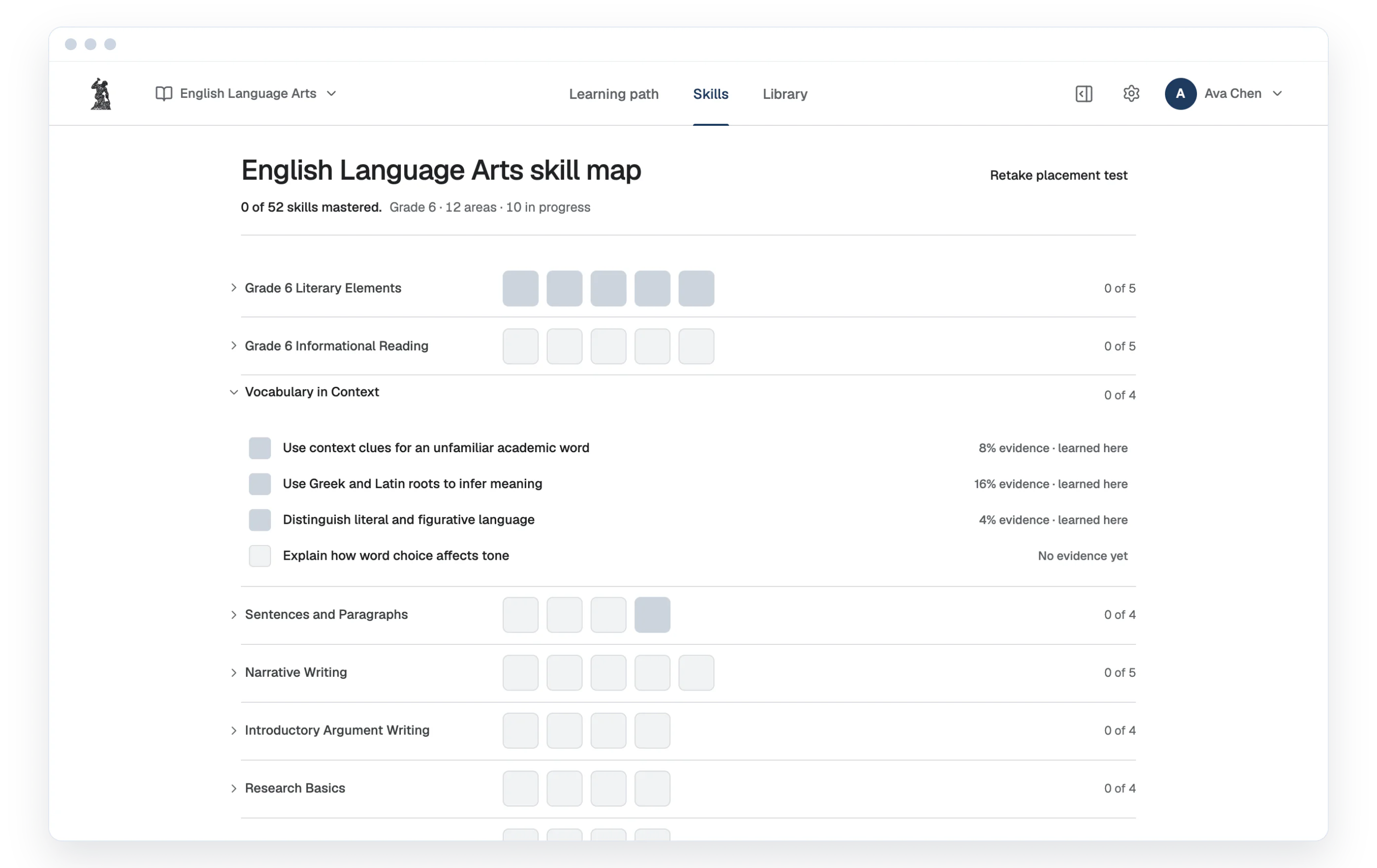
Review checkpoints come back at least every three lesson groups, so newly learned skills come back before they can slip. On the skill map, you can watch the evidence for each skill fill in as your child works, instead of waiting for a report card.
Strengths get the same treatment. A teen who places ahead in a subject starts at that level and keeps going.
A child who has stopped caring about school
Many late starters arrive tired of school, and motivation does not come back because a parent asks for it. It comes back when the work fits and the student has a say. During setup, you and your child choose a mentor, a historical figure such as Aristotle.
Your child can describe their interests and a direction they want to explore, such as building games or becoming a vet.
Lessons draw examples from those interests where one fits honestly. On School in a Box, our full plan with up to 12 subjects at once, any topic your child cares about can become a custom elective. Lessons can connect to those interests, and School in a Box can turn a topic into a custom elective.
Submitted projects receive feedback and can be revised, giving your child concrete evidence of progress in the new setting.
Build independence from a lesson that fits
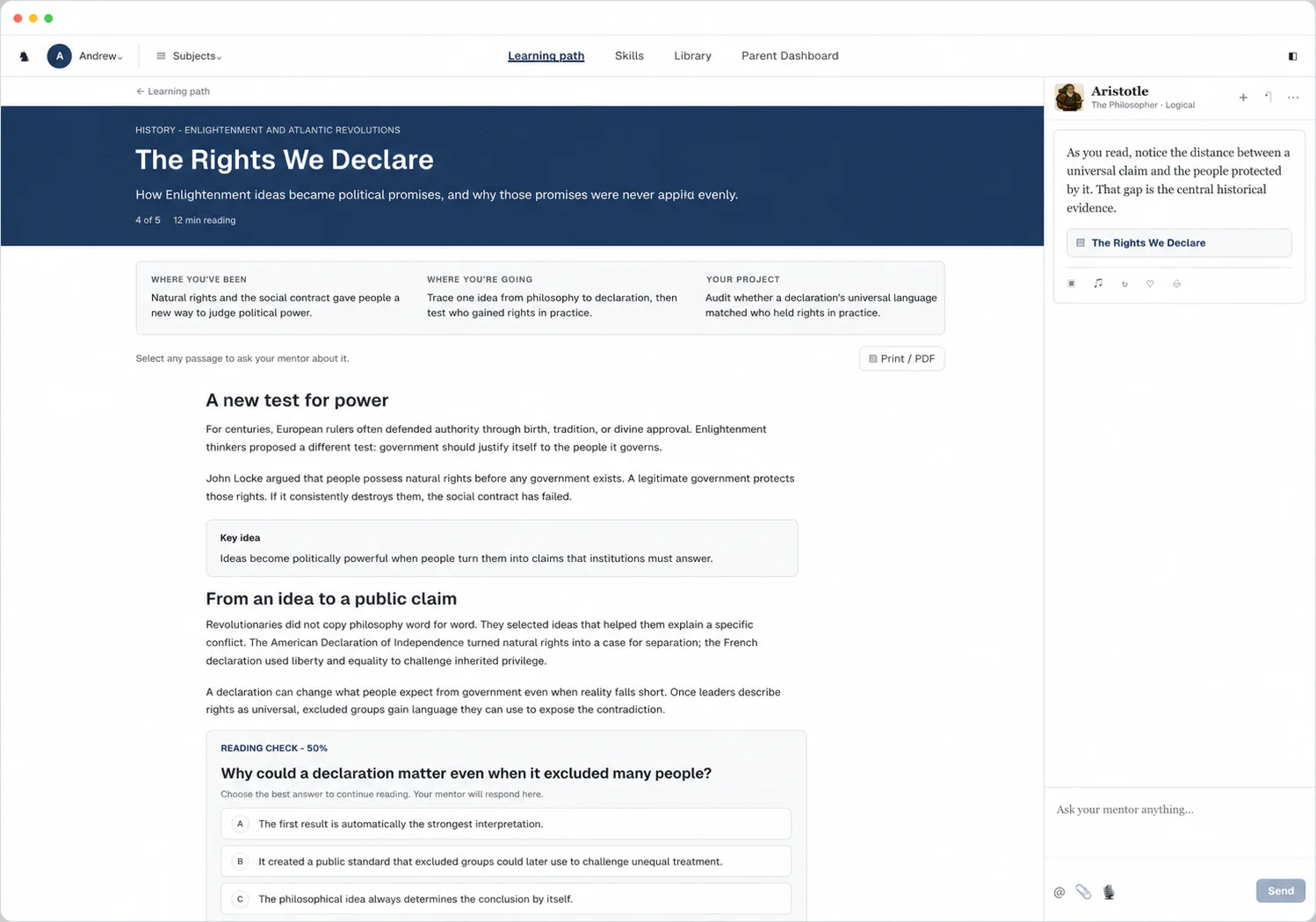
An older child can begin with the next lesson and use the Always-On Mentor for an explanation or drawing. A manageable starting level and help inside the reading give the first weeks a practical structure.
Use actual submitted work to decide what should change. Independent checks require the learner’s answer, and projects can be revised from feedback, so you can see progress without treating the opening placement result as final.
Joining during high school
Credits your teen earned at school stay on that school's transcript, and colleges read it alongside ours.
From the first year here, each subject your teen works in becomes a line on the transcript we generate, with credits counted from the hours of completed lessons: 120 hours make a credit, and a subject under 15 hours in a year shows no credit yet. Course descriptions list each course's lessons, hours, and topics.
Graduation is set by the homeschool, which means you, as its administrator, decide when your teen has finished, within your state's rules. Some states set no credit count at all; Texas is one. We do not provide a four-year planner or a graduation tracker, so our graduation requirements by state guide is the place to check what yours expects.
When your teen finishes, we generate the diploma with your homeschool's name, ready for your signature.
Starting in middle school: the years to fill gaps
For a child of 11 to 13, a late start is often the best timing there is. Nothing is on a transcript yet, so the years before 9th grade can go to closing the gaps that would otherwise follow your child into algebra, biology, and essay writing.
A child who reaches high school with those skills in place can start the courses that count, including advanced courses built on AP frameworks, from strength.
Middle school is also when your child can practice running their own day while the stakes are low. By 9th grade, a student who already checks in, works through the Today card, and takes questions to the mentor is ready for courses that count.
What a late start asks of you
Your part is the legal step and the conversation. If your child is enrolled, follow your state's withdrawal and notice rules; our guide to withdrawing from school mid-year walks through them, and the document tools draft the documents for you to sign. Then talk with your child about why you are making the change and what they want from it.
After that, our Parent Dashboard, your view of your child's day, grades, and records, shows each subject's grade level and mastery, today's lessons, and anything that needs you, without you needing to teach or grade anything.
Frequently asked questions
- Can my teen still graduate on time?
- Usually. Credits with us build as lessons are completed, and you decide when the courses you set are finished. A teen who arrives behind in one subject can start there without slowing the others.
- Will colleges accept a transcript that starts in 11th grade?
- Colleges read transfer records all the time. They see the old school's transcript for the early years and ours for the years at home, with course descriptions for each of our courses.
- Should an older child take a break before starting?
- Sometimes, especially after a hard year. Our guide to deschooling covers how long and what the law still expects during it.
Start from where your child is today
Placement finds the gaps and strengths years of school left, and each course begins right there.
$149/month per child after the trial.
Sources (6)
- Florida Statutes section 1003.21: school attendance
- Pennsylvania Department of Education: Home Education and Private Tutoring
- Ohio Department of Education and Workforce: Home Education Fact Sheet
- Georgia Department of Education: Home Study Guidance
- North Carolina Division of Non-Public Education: home school FAQs
- California Department of Education: Schooling at Home FAQ