AP Art History exam prep for homeschoolers.
Close looking comes first: your student studies works of art in context, then writes from the visual evidence.
Practice, with a record of the work
Students study objects across cultures and periods, compare visual choices, and support interpretations with historical context and evidence. The subject map lists 20 units and 100 skills, starting with global prehistoric art, ancient Mediterranean art, and early Europe and colonial Americas.
- Annotated image analyses
- Comparative essays using visual and contextual evidence
- Timed attribution and interpretation responses
A personalized lesson from the course
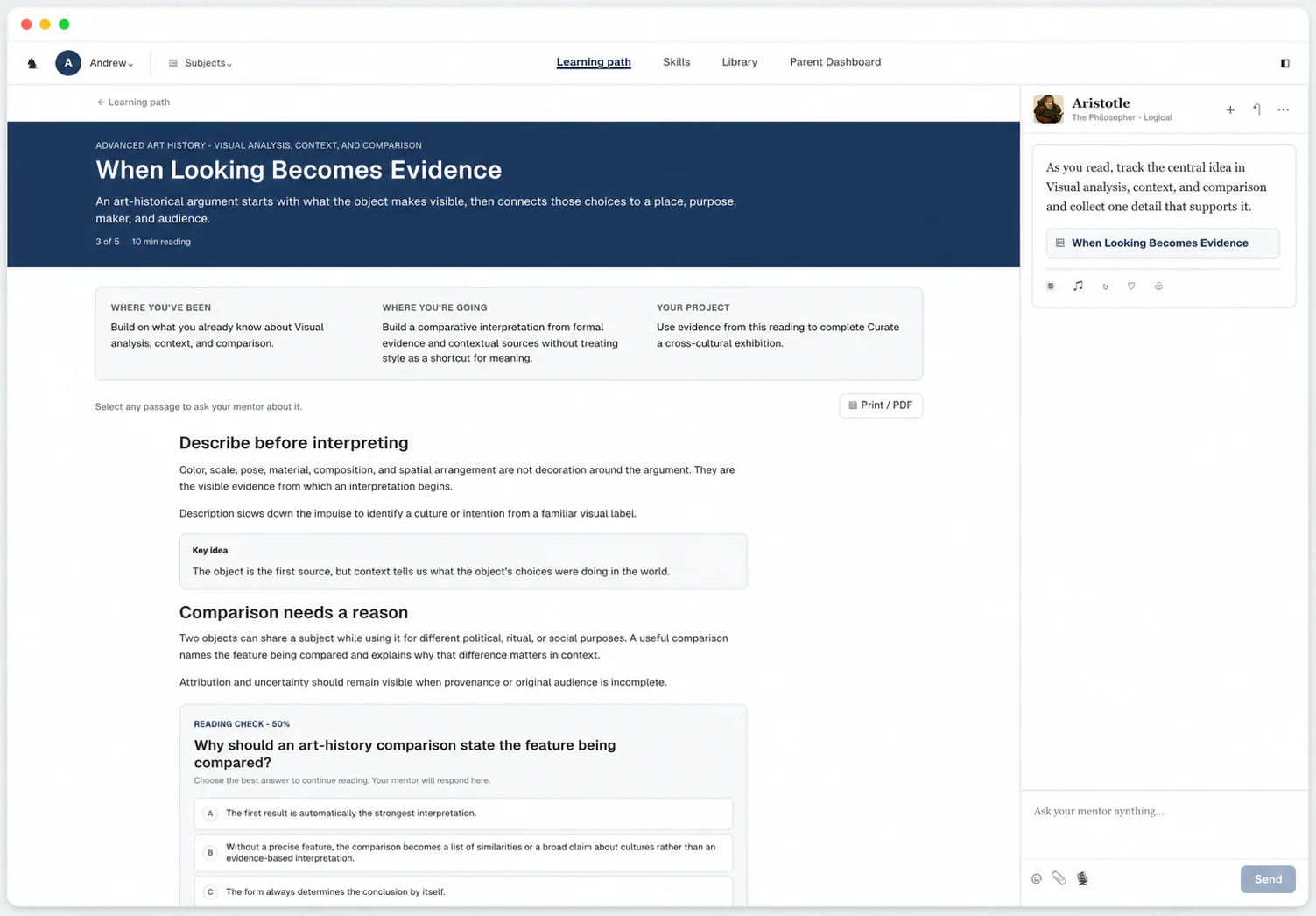
An art-historical argument starts with what the object makes visible, then connects those choices to a place, purpose, maker, and audience.
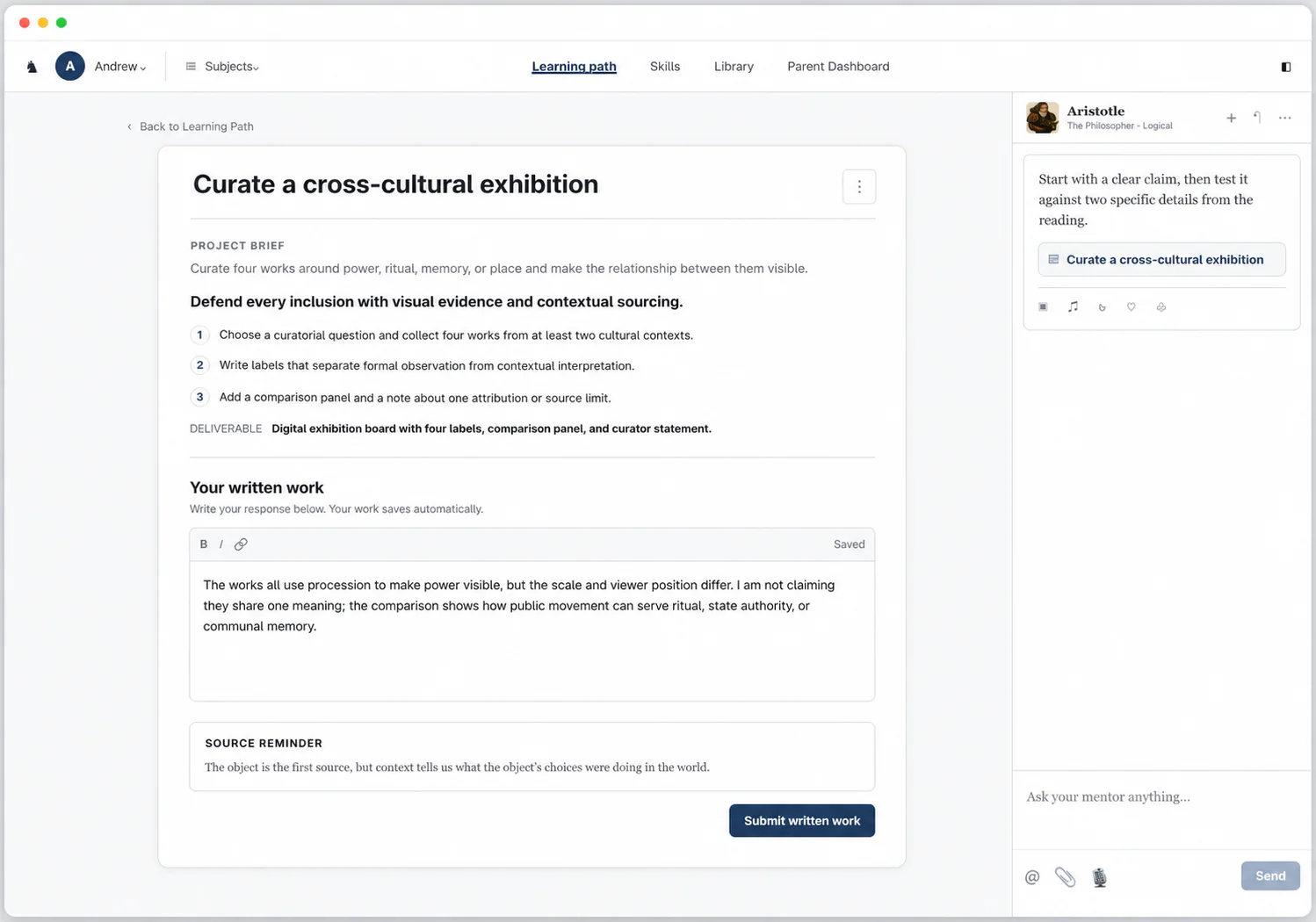
Curate a cross-cultural exhibition
Curate four works around power, ritual, memory, or place and make the relationship between them visible.
Our Always-On Mentor can help your teen add a comparison panel and a note about one attribution or source limit.
Units and skills
AP Art History exam prep20 units · 100 skills
Global prehistoric art5 skills
- Analyze formal choices and relationships in Global prehistoric art
- Explain how context, purpose, and audience shape Global prehistoric art
- Develop and test an original inquiry through Global prehistoric art
- Document experimentation, critique, and revision in Global prehistoric art
- Select, justify, and present evidence of mastery in Global prehistoric art
Ancient Mediterranean art5 skills
- Analyze formal choices and relationships in Ancient Mediterranean art
- Explain how context, purpose, and audience shape Ancient Mediterranean art
- Develop and test an original inquiry through Ancient Mediterranean art
- Document experimentation, critique, and revision in Ancient Mediterranean art
- Select, justify, and present evidence of mastery in Ancient Mediterranean art
Early Europe and colonial Americas5 skills
- Analyze formal choices and relationships in Early Europe and colonial Americas
- Explain how context, purpose, and audience shape Early Europe and colonial Americas
- Develop and test an original inquiry through Early Europe and colonial Americas
- Document experimentation, critique, and revision in Early Europe and colonial Americas
- Select, justify, and present evidence of mastery in Early Europe and colonial Americas
Later Europe and Americas5 skills
- Analyze formal choices and relationships in Later Europe and Americas
- Explain how context, purpose, and audience shape Later Europe and Americas
- Develop and test an original inquiry through Later Europe and Americas
- Document experimentation, critique, and revision in Later Europe and Americas
- Select, justify, and present evidence of mastery in Later Europe and Americas
Indigenous Americas5 skills
- Analyze formal choices and relationships in Indigenous Americas
- Explain how context, purpose, and audience shape Indigenous Americas
- Develop and test an original inquiry through Indigenous Americas
- Document experimentation, critique, and revision in Indigenous Americas
- Select, justify, and present evidence of mastery in Indigenous Americas
Africa5 skills
- Analyze formal choices and relationships in Africa
- Explain how context, purpose, and audience shape Africa
- Develop and test an original inquiry through Africa
- Document experimentation, critique, and revision in Africa
- Select, justify, and present evidence of mastery in Africa
West and Central Asia5 skills
- Analyze formal choices and relationships in West and Central Asia
- Explain how context, purpose, and audience shape West and Central Asia
- Develop and test an original inquiry through West and Central Asia
- Document experimentation, critique, and revision in West and Central Asia
- Select, justify, and present evidence of mastery in West and Central Asia
South, East, and Southeast Asia5 skills
- Analyze formal choices and relationships in South, East, and Southeast Asia
- Explain how context, purpose, and audience shape South, East, and Southeast Asia
- Develop and test an original inquiry through South, East, and Southeast Asia
- Document experimentation, critique, and revision in South, East, and Southeast Asia
- Select, justify, and present evidence of mastery in South, East, and Southeast Asia
Pacific art5 skills
- Analyze formal choices and relationships in Pacific art
- Explain how context, purpose, and audience shape Pacific art
- Develop and test an original inquiry through Pacific art
- Document experimentation, critique, and revision in Pacific art
- Select, justify, and present evidence of mastery in Pacific art
Global contemporary art5 skills
- Analyze formal choices and relationships in Global contemporary art
- Explain how context, purpose, and audience shape Global contemporary art
- Develop and test an original inquiry through Global contemporary art
- Document experimentation, critique, and revision in Global contemporary art
- Select, justify, and present evidence of mastery in Global contemporary art
Visual and contextual analysis5 skills
- Analyze formal choices and relationships in Visual and contextual analysis
- Explain how context, purpose, and audience shape Visual and contextual analysis
- Develop and test an original inquiry through Visual and contextual analysis
- Document experimentation, critique, and revision in Visual and contextual analysis
- Select, justify, and present evidence of mastery in Visual and contextual analysis
Comparison and attribution5 skills
- Analyze formal choices and relationships in Comparison and attribution
- Explain how context, purpose, and audience shape Comparison and attribution
- Develop and test an original inquiry through Comparison and attribution
- Document experimentation, critique, and revision in Comparison and attribution
- Select, justify, and present evidence of mastery in Comparison and attribution
Source credibility and provenance5 skills
- Analyze formal choices and relationships in Source credibility and provenance
- Explain how context, purpose, and audience shape Source credibility and provenance
- Develop and test an original inquiry through Source credibility and provenance
- Document experimentation, critique, and revision in Source credibility and provenance
- Select, justify, and present evidence of mastery in Source credibility and provenance
Claim, evidence, and reasoning5 skills
- Analyze formal choices and relationships in Claim, evidence, and reasoning
- Explain how context, purpose, and audience shape Claim, evidence, and reasoning
- Develop and test an original inquiry through Claim, evidence, and reasoning
- Document experimentation, critique, and revision in Claim, evidence, and reasoning
- Select, justify, and present evidence of mastery in Claim, evidence, and reasoning
Counterargument and qualification5 skills
- Analyze formal choices and relationships in Counterargument and qualification
- Explain how context, purpose, and audience shape Counterargument and qualification
- Develop and test an original inquiry through Counterargument and qualification
- Document experimentation, critique, and revision in Counterargument and qualification
- Select, justify, and present evidence of mastery in Counterargument and qualification
Formal visual analysis5 skills
- Analyze formal choices and relationships in Formal visual analysis
- Explain how context, purpose, and audience shape Formal visual analysis
- Develop and test an original inquiry through Formal visual analysis
- Document experimentation, critique, and revision in Formal visual analysis
- Select, justify, and present evidence of mastery in Formal visual analysis
Context, purpose, and audience5 skills
- Analyze formal choices and relationships in Context, purpose, and audience
- Explain how context, purpose, and audience shape Context, purpose, and audience
- Develop and test an original inquiry through Context, purpose, and audience
- Document experimentation, critique, and revision in Context, purpose, and audience
- Select, justify, and present evidence of mastery in Context, purpose, and audience
Advanced Art History cumulative assessment5 skills
- Analyze formal choices and relationships in Advanced Art History cumulative assessment
- Explain how context, purpose, and audience shape Advanced Art History cumulative assessment
- Develop and test an original inquiry through Advanced Art History cumulative assessment
- Document experimentation, critique, and revision in Advanced Art History cumulative assessment
- Select, justify, and present evidence of mastery in Advanced Art History cumulative assessment
Advanced Art History exam-mode practice5 skills
- Analyze formal choices and relationships in Advanced Art History exam-mode practice
- Explain how context, purpose, and audience shape Advanced Art History exam-mode practice
- Develop and test an original inquiry through Advanced Art History exam-mode practice
- Document experimentation, critique, and revision in Advanced Art History exam-mode practice
- Select, justify, and present evidence of mastery in Advanced Art History exam-mode practice
Advanced Art History reflection and transfer5 skills
- Analyze formal choices and relationships in Advanced Art History reflection and transfer
- Explain how context, purpose, and audience shape Advanced Art History reflection and transfer
- Develop and test an original inquiry through Advanced Art History reflection and transfer
- Document experimentation, critique, and revision in Advanced Art History reflection and transfer
- Select, justify, and present evidence of mastery in Advanced Art History reflection and transfer
Questions parents ask
What work will my teen do in this course?
- The course explores ideas in Advanced Art History. Your teen explains and applies the ideas in written responses and projects, so the work shows which skills are secure and which need more practice.
How does a homeschooler register for an AP exam?
- An AP coordinator at an AP-authorized local school arranges registration. Use College Board’s homeschool exam guidance to find a host school. That school sets its deadlines and outside-student policies; its coordinator orders the exam, collects fees, and tells your child where and when to test.
Which course title goes on a homeschool transcript?
- Advanced Art History, not AP Art History. The AP designation requires College Board Course Audit authorization of the course, which following the framework does not give. We generate the transcript with that title, ready for you to sign as homeschool administrator.
How can AP scores earn college credit?
- Colleges award credit under their own score policies. College Board reports scores on a 1–5 scale, separately from our coursework grades; check the college’s required score and whether it grants credit, placement, or both.
AP Art History exam prep, with the teaching and records handled
$49/month after the trial.
Sources (6)
AP is a trademark registered by the College Board, which is not affiliated with, and does not endorse, this site.