AP exam prep courses. Built around your child.
Choose from 40 courses in the arts, sciences, languages, and more. Each focuses on its subject, with lessons, projects, feedback, and a saved course record. Exam or portfolio access is arranged separately.
Inside the literature exam prep
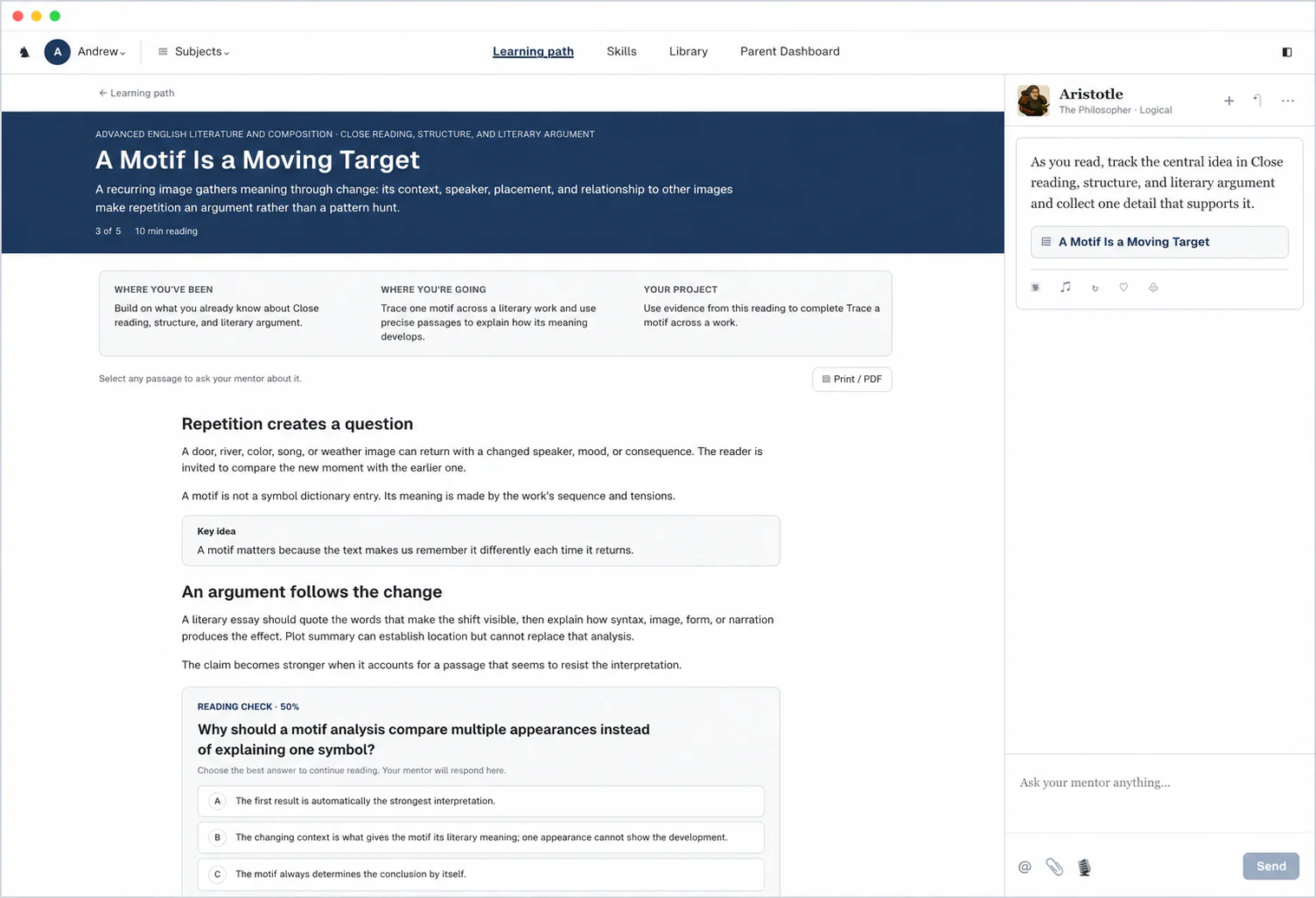
A recurring image gathers meaning through change: its context, speaker, placement, and relationship to other images make repetition an argument rather than a pattern hunt.
What each course covers
Each course explores ideas in an advanced subject through reading, written work, and projects. The catalog covers arts, English, history and social sciences, math and computer science, sciences, world languages, Seminar, and Research.
AP Biology exam prep, for example, explores biological processes through diagrams, data, and arguments supported by evidence. Each course page describes the subject and the work your teen produces.
Lessons vary the support and depth for the learner, with practice in the subject’s ideas and skills.
How we teach and grade it
Your teen reads, answers short checks, and applies the ideas in a project. Our Always-On Mentor can discuss a passage they highlight or help them examine the evidence for an argument. During a Reading Check it can clarify the question while leaving the answer to your teen.
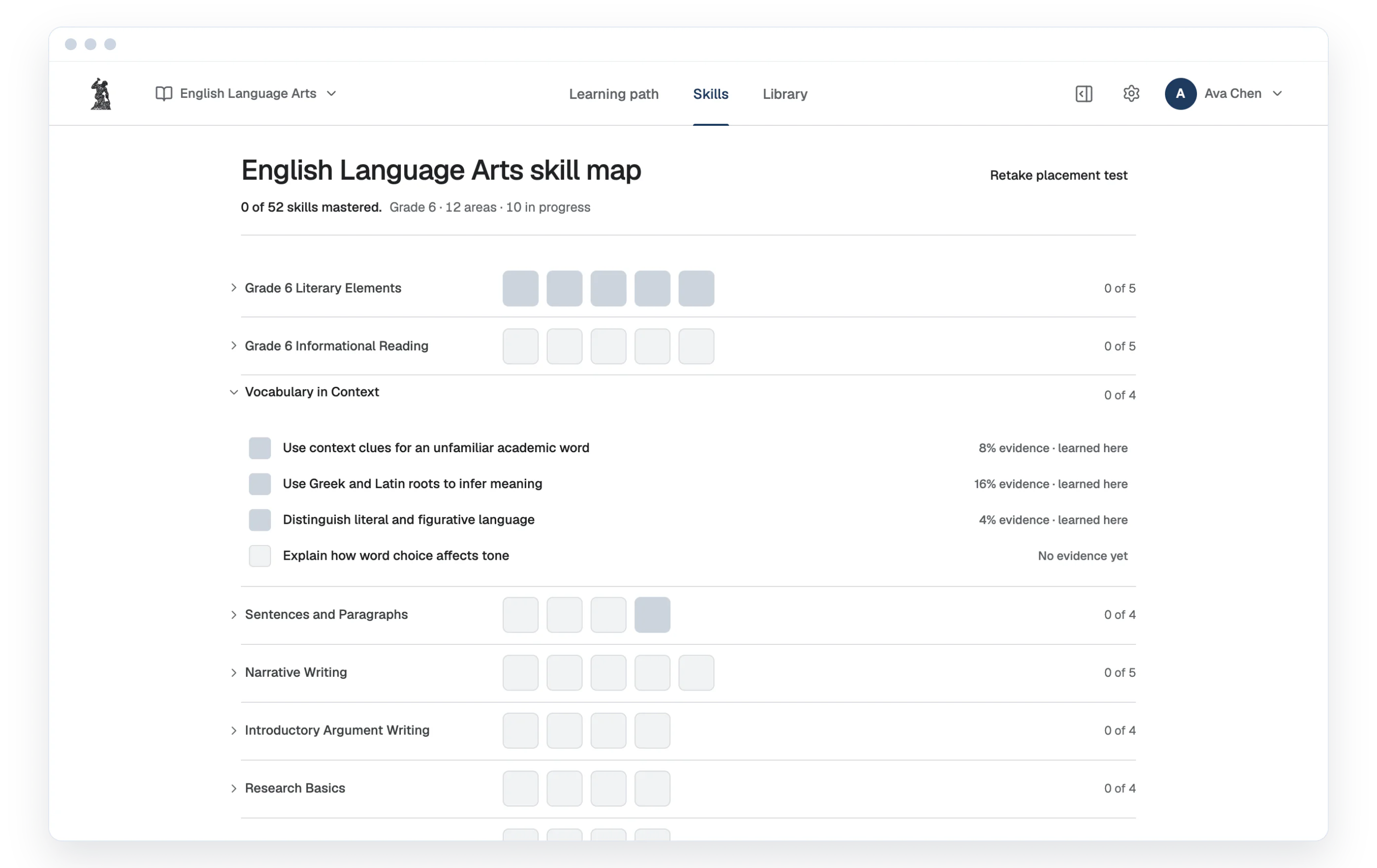
Written projects come back graded with feedback your teen can use to revise. The saved drafts let them return to an earlier argument, calculation, or design and explain what changed.
Science courses focus on scientific ideas, data, and written explanations. Labs are not included. Your family arranges any hands-on activities, equipment, a safe workspace, and adult supervision separately.
Choose a course
- Arts 5
- English 2
- History & Social Sciences 10
- Mathematics & Computer Science 6
- Sciences 7
- World Languages 8
- Capstone 2
2-D Art and Design
Inquiry and sustained investigation; Design elements and principles; Photography and image making.
3-D Art and Design
Inquiry and sustained investigation; Three-dimensional design principles; Form and volume.
Drawing
Inquiry and sustained investigation; Line and mark making; Light and value.
Art History
Global prehistoric art; Ancient Mediterranean art; Early Europe and colonial Americas.
Music Theory
Pitch and notation; Rhythm and meter; Scales, keys, and modes.
English Language and Composition
Rhetorical situation; Claims and evidence; Reasoning and organization.
English Literature and Composition
Close reading; Character; Setting.
African American Studies
Origins of the African diaspora; Freedom, enslavement, and resistance; The practice of freedom.
Comparative Government and Politics
Political systems and regimes; Political institutions; Political culture and participation.
European History
Renaissance and exploration; Age of Reformation; Absolutism and constitutionalism.
Human Geography
Geographic thinking; Population and migration; Cultural patterns.
Macroeconomics
Basic economic concepts; Economic indicators and the business cycle; National income and price determination.
Microeconomics
Basic economic concepts; Supply and demand; Production, cost, and the perfect competition model.
Psychology
Biological bases of behavior; Cognition; Development and learning.
United States Government and Politics
Foundations of American democracy; Interactions among branches; Civil liberties and civil rights.
United States History
Indigenous societies and European contact; Colonial society; Revolution and the new nation.
World History: Modern
The global tapestry; Networks of exchange; Land-based empires.
Precalculus
Polynomial and rational functions; Exponential and logarithmic functions; Trigonometric and polar functions.
Calculus AB
Limits and continuity; Differentiation fundamentals; Composite, implicit, and inverse differentiation.
Calculus BC
Limits and continuity; Differentiation; Applications of differentiation.
Statistics
Exploring one-variable data; Exploring two-variable data; Collecting data.
Computer Science Principles
Creative development; Data; Algorithms and programming.
Computer Science A
Primitive types; Using objects; Boolean expressions and control flow.
Biology
Chemistry of life; Cell structure and function; Cellular energetics.
Chemistry
Atomic structure and properties; Molecular and ionic structure; Intermolecular forces and properties.
Environmental Science
The living world: ecosystems; The living world: biodiversity; Populations.
Physics 1: Algebra-Based
Kinematics; Force and translational dynamics; Work, energy, and power.
Physics 2: Algebra-Based
Thermodynamics; Electric force, field, and potential; Electric circuits.
Physics C: Mechanics
Kinematics; Force and translational dynamics; Work, energy, and power.
Physics C: Electricity and Magnetism
Electrostatics; Conductors, capacitors, and dielectrics; Electric circuits.
Chinese Language and Culture
Families and communities; Personal and public identities; Beauty and aesthetics.
French Language and Culture
Families and communities; Personal and public identities; Beauty and aesthetics.
German Language and Culture
Families and communities; Personal and public identities; Beauty and aesthetics.
Italian Language and Culture
Families and communities; Personal and public identities; Beauty and aesthetics.
Japanese Language and Culture
Families and communities; Personal and public identities; Beauty and aesthetics.
Latin
Vergil: Aeneid selections; Pliny: Letters selections; Sight reading prose.
Spanish Language and Culture
Families and communities; Personal and public identities; Beauty and aesthetics.
Spanish Literature and Culture
Medieval literature; Golden Age literature; Nineteenth-century literature.
Taking the AP exam as a homeschooler
Enrolling in a course does not register your teen for the AP exam. College Board gives its exams through schools, so a homeschooled student tests at a local school that offers them. That school's AP coordinator orders the exam, collects the fee, and tells your teen where and when to report.
Timing matters more than anything else here. Schools send their exam orders to College Board by mid-November, and each school sets its own deadline and rules for outside students, so the school needs to hear from you early in the fall. College Board's AP Course Ledger lists the schools that offer each subject, and the AP coordinator at a nearby one can say whether it is taking homeschooled students this year. Exams are given over two weeks in May, and scores come out in July on a 1 to 5 scale.
Courses scored by portfolio or class project
The three art courses, 2-D Art and Design, 3-D Art and Design, and Drawing, have no sit-down exam. Your teen submits a digital portfolio through AP Digital Portfolio by College Board's May deadline, with access arranged by an AP coordinator. Our art courses keep every trial, critique, revision, and finished piece together, so the portfolio is built as the course goes.
AP Seminar and AP Research scores require a teacher-led class at a participating school; College Board does not allow independent study for either. Our capstone courses teach the same research and argument skills, and the official score needs that class. AP Computer Science Principles adds the Create performance task to its exam, and AP African American Studies adds an individual student project, both arranged through an AP coordinator.
On the transcript and for college credit
Each course goes on the transcript we generate like any other course, with its credits and grade, and the weighted GPA counts it one point higher, the way schools weight AP classes. Credits come from the hours we estimate from the lessons your teen completed, at 120 hours a credit.
College Board reserves the AP course name for courses it has approved through its AP Course Audit, so the transcript lists ours with Advanced titles, such as Advanced Biology. The exam score is separate from our grade: College Board reports it, and each college decides from its own policy whether a score earns credit, placement, or both.
FAQ
Can my teen take an AP exam without one of these courses?
- Yes, for most exams. College Board lets students self-study for most AP Exams, though it recommends taking the course first.
Does the course count if my teen skips the exam?
- Yes. The course, its grade, and its credits go on the transcript whether or not your teen sits the AP exam.
Start a course with your teen
$49/month after the trial.
Sources (13)
- College Board: AP Course Audit for homeschool providers
- College Board: Self-study and AP courses
- College Board: Find an AP exam school
- College Board: Join a class or exam section
- College Board: AP scores
- College Board: College credit and placement
- College Board: African American Studies assessment
- College Board: Art portfolio submission
- College Board: AP Capstone policies
- College Board: Computer Science Principles assessment
- College Board: AP 2-D Art and Design portfolio requirements
- College Board: AP 3-D Art and Design portfolio requirements
- College Board: AP Drawing portfolio requirements
AP is a trademark registered by the College Board, which is not affiliated with, and does not endorse, this site.