AP Physics 1: Algebra-Based exam prep for homeschoolers.
Models and calculations connect motion, forces, energy, and momentum.
From investigation to evidence
Your student uses algebra to explain how objects move, from a cart accelerating along a track to a rotating system. They connect position-time graphs, force diagrams, energy, and momentum with measurements, then explain how friction or an uncertain measurement affects a prediction. Geometry is recommended, with Algebra II taken before or alongside the course. The subject map lists 22 units and 66 skills, starting with kinematics; force and translational dynamics; and work, energy, and power.
- Motion models and written explanations
- Diagram, graph, equation, and verbal translations
- Experimental-design and quantitative free responses
A personalized lesson from the course
A physics model earns trust when diagrams, equations, measurements, and assumptions agree closely enough to explain a real motion.
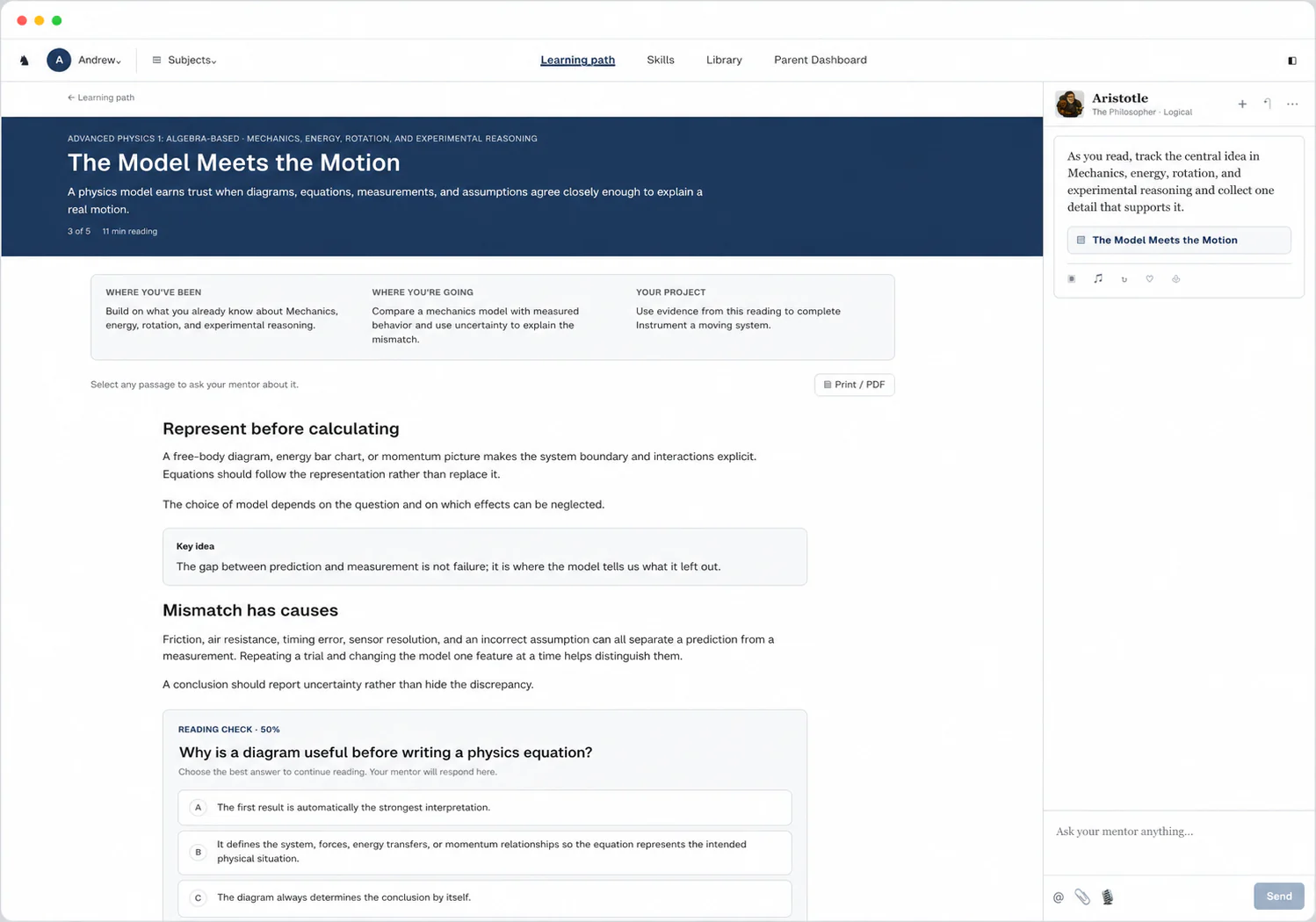
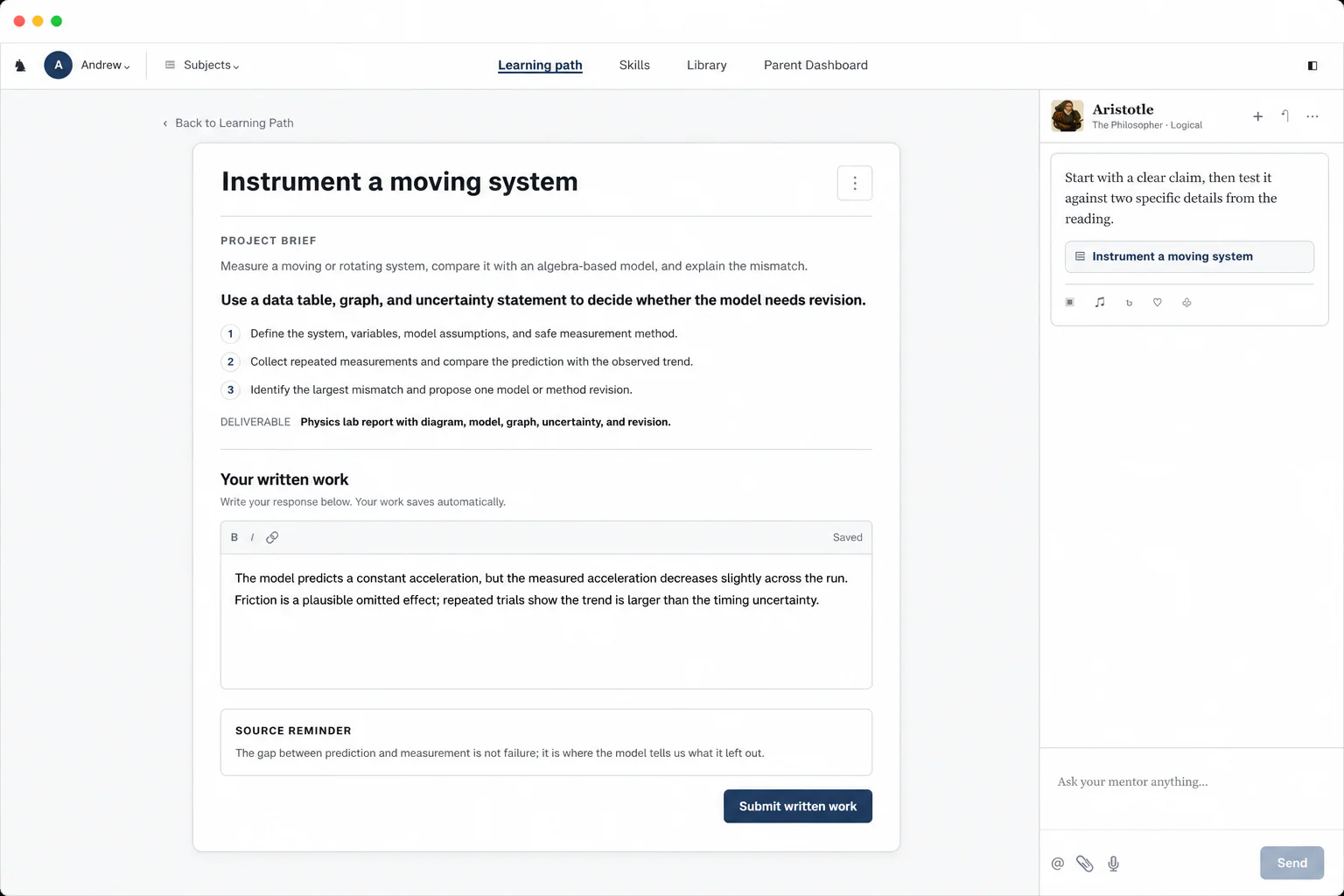
Instrument a moving system
Measure a moving or rotating system, compare it with an algebra-based model, and explain the mismatch.
Our Always-On Mentor can help your teen identify the largest mismatch and propose one model or method revision.
Units and skills
AP Physics 1: Algebra-Based exam prep22 units · 66 skills
Kinematics3 skills
- Create and connect physical representations of Kinematics
- Apply mathematical routines to Kinematics
- Design an investigation or construct a scientific argument about Kinematics
Force and translational dynamics3 skills
- Create and connect physical representations of Force and translational dynamics
- Apply mathematical routines to Force and translational dynamics
- Design an investigation or construct a scientific argument about Force and translational dynamics
Work, energy, and power3 skills
- Create and connect physical representations of Work, energy, and power
- Apply mathematical routines to Work, energy, and power
- Design an investigation or construct a scientific argument about Work, energy, and power
Linear momentum3 skills
- Create and connect physical representations of Linear momentum
- Apply mathematical routines to Linear momentum
- Design an investigation or construct a scientific argument about Linear momentum
Torque and rotational dynamics3 skills
- Create and connect physical representations of Torque and rotational dynamics
- Apply mathematical routines to Torque and rotational dynamics
- Design an investigation or construct a scientific argument about Torque and rotational dynamics
Energy and momentum of rotating systems3 skills
- Create and connect physical representations of Energy and momentum of rotating systems
- Apply mathematical routines to Energy and momentum of rotating systems
- Design an investigation or construct a scientific argument about Energy and momentum of rotating systems
Oscillations3 skills
- Create and connect physical representations of Oscillations
- Apply mathematical routines to Oscillations
- Design an investigation or construct a scientific argument about Oscillations
Fluids3 skills
- Create and connect physical representations of Fluids
- Apply mathematical routines to Fluids
- Design an investigation or construct a scientific argument about Fluids
Experimental design3 skills
- Create and connect physical representations of Experimental design
- Apply mathematical routines to Experimental design
- Design an investigation or construct a scientific argument about Experimental design
Data and uncertainty3 skills
- Create and connect physical representations of Data and uncertainty
- Apply mathematical routines to Data and uncertainty
- Design an investigation or construct a scientific argument about Data and uncertainty
Scientific argumentation3 skills
- Create and connect physical representations of Scientific argumentation
- Apply mathematical routines to Scientific argumentation
- Design an investigation or construct a scientific argument about Scientific argumentation
Cumulative mechanics investigation3 skills
- Create and connect physical representations of Cumulative mechanics investigation
- Apply mathematical routines to Cumulative mechanics investigation
- Design an investigation or construct a scientific argument about Cumulative mechanics investigation
Safe experimental practice3 skills
- Create and connect physical representations of Safe experimental practice
- Apply mathematical routines to Safe experimental practice
- Design an investigation or construct a scientific argument about Safe experimental practice
Inquiry design and variable control3 skills
- Create and connect physical representations of Inquiry design and variable control
- Apply mathematical routines to Inquiry design and variable control
- Design an investigation or construct a scientific argument about Inquiry design and variable control
Raw data, uncertainty, and error3 skills
- Create and connect physical representations of Raw data, uncertainty, and error
- Apply mathematical routines to Raw data, uncertainty, and error
- Design an investigation or construct a scientific argument about Raw data, uncertainty, and error
Laboratory notebook and scientific communication3 skills
- Create and connect physical representations of Laboratory notebook and scientific communication
- Apply mathematical routines to Laboratory notebook and scientific communication
- Design an investigation or construct a scientific argument about Laboratory notebook and scientific communication
Multiple quantitative representations3 skills
- Create and connect physical representations of Multiple quantitative representations
- Apply mathematical routines to Multiple quantitative representations
- Design an investigation or construct a scientific argument about Multiple quantitative representations
Graph construction and interpretation3 skills
- Create and connect physical representations of Graph construction and interpretation
- Apply mathematical routines to Graph construction and interpretation
- Design an investigation or construct a scientific argument about Graph construction and interpretation
Written mathematical justification3 skills
- Create and connect physical representations of Written mathematical justification
- Apply mathematical routines to Written mathematical justification
- Design an investigation or construct a scientific argument about Written mathematical justification
Advanced Physics 1: Algebra-Based cumulative assessment3 skills
- Create and connect physical representations of Advanced Physics 1: Algebra-Based cumulative assessment
- Apply mathematical routines to Advanced Physics 1: Algebra-Based cumulative assessment
- Design an investigation or construct a scientific argument about Advanced Physics 1: Algebra-Based cumulative assessment
Advanced Physics 1: Algebra-Based exam-mode practice3 skills
- Create and connect physical representations of Advanced Physics 1: Algebra-Based exam-mode practice
- Apply mathematical routines to Advanced Physics 1: Algebra-Based exam-mode practice
- Design an investigation or construct a scientific argument about Advanced Physics 1: Algebra-Based exam-mode practice
Advanced Physics 1: Algebra-Based reflection and transfer3 skills
- Create and connect physical representations of Advanced Physics 1: Algebra-Based reflection and transfer
- Apply mathematical routines to Advanced Physics 1: Algebra-Based reflection and transfer
- Design an investigation or construct a scientific argument about Advanced Physics 1: Algebra-Based reflection and transfer
Questions parents ask
What work will my teen do in this course?
- The course explores ideas in Advanced Physics 1: Algebra-Based. Your teen explains and applies the ideas in written responses and projects, so the work shows which skills are secure and which need more practice.
How does a homeschooler register for an AP exam?
- An AP coordinator at an AP-authorized local school arranges registration. Use College Board’s homeschool exam guidance to find a host school. That school sets its deadlines and outside-student policies; its coordinator orders the exam, collects fees, and tells your child where and when to test.
Which course title goes on a homeschool transcript?
- Advanced Physics 1: Algebra-Based, not AP Physics 1: Algebra-Based. The AP designation requires College Board Course Audit authorization of the course, which following the framework does not give. We generate the transcript with that title, ready for you to sign as homeschool administrator.
How can AP scores earn college credit?
- Colleges award credit under their own score policies. College Board reports scores on a 1–5 scale, separately from our coursework grades; check the college’s required score and whether it grants credit, placement, or both.
Who arranges the labs and equipment?
- Labs are not included in the course. Your family arranges any hands-on activities, equipment, a safe workspace, and adult supervision separately.
AP Physics 1: Algebra-Based exam prep, with the teaching and records handled
$49/month after the trial.
Sources (6)
AP is a trademark registered by the College Board, which is not affiliated with, and does not endorse, this site.