What a homeschool curriculum has to do, how ours places, teaches, grades, and records every subject, what children learn at each stage, and how to judge it in two weeks.
The five jobs a curriculum has to do
Strip away the marketing and a curriculum does five jobs. It sets a sequence, so fractions come after division and essays come after paragraphs. It teaches each step. It gives practice. It checks whether the step stuck. And it leaves a record you can show someone later.
Homeschool curricula differ mainly in who does each job. In many, the parent teaches from a guide, marks the work, and keeps the records, so the curriculum is really a plan for the parent's day. Ours is built to do all five jobs itself, which is why you can homeschool with us without becoming a teacher. The rest of this guide shows how each job works.
Sequence: each subject starts where your child is
A school grade does not describe every skill a child has learned. A 10-year-old who devours chapter books but still counts on fingers to multiply needs two different starting points, and one grade level gets one of them wrong.
Placement checks the starting point in each subject. It adapts as your child answers. It is 25 questions and untimed; for kindergarten through 2nd grade it is 12 questions, every one read aloud. The result is a starting grade for that subject. Skills your child showed they know are skipped, and any earlier gaps come first.
From there, each subject is a path of units in a fixed order, so no skill is skipped. Your child moves forward by showing each one, and review checkpoints come back at least every three lesson groups.
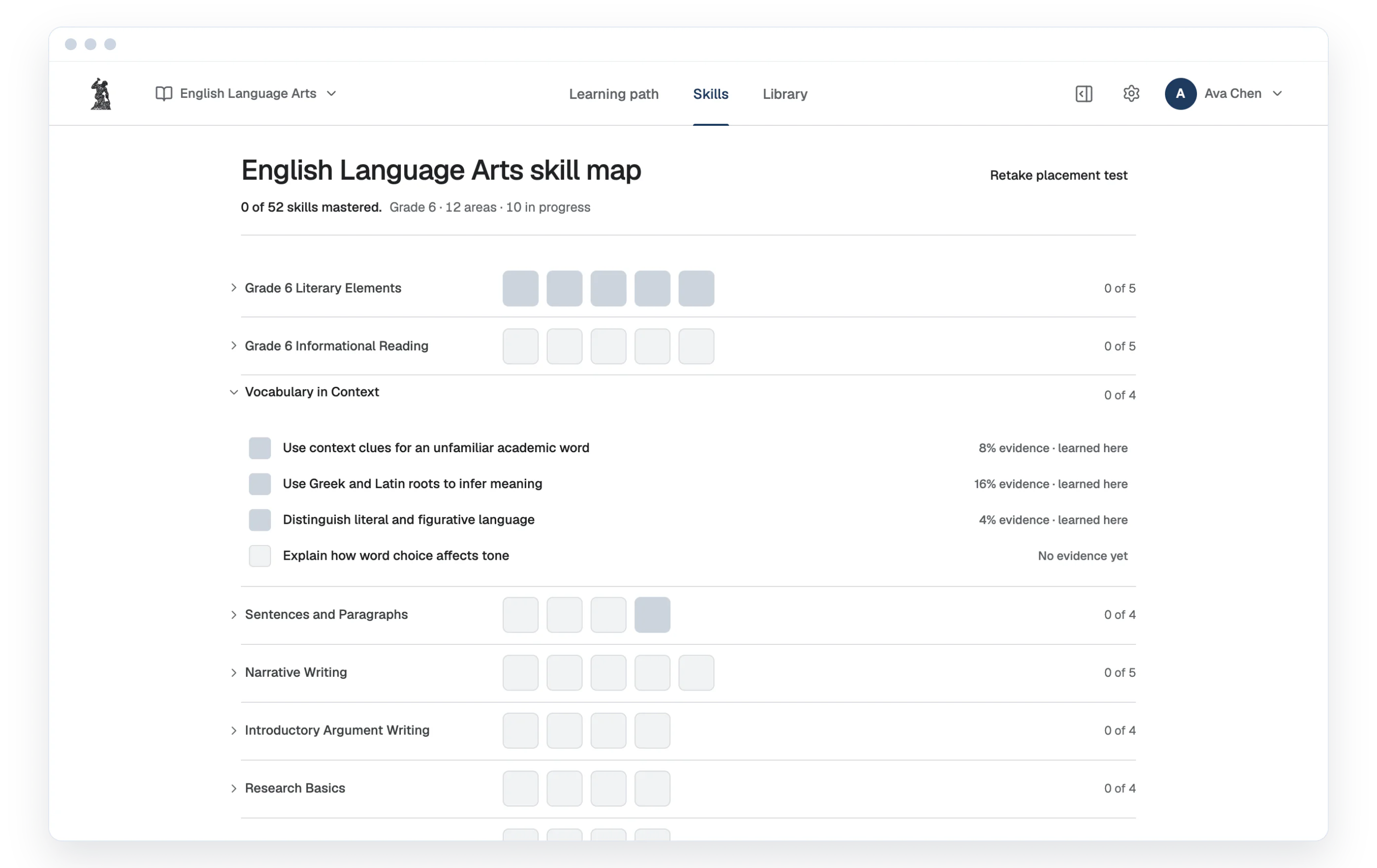
The skill map shows every skill in a course and how much evidence your child has shown for it, with a link to retake placement if a starting point turns out wrong.
Teaching: lessons written for your child
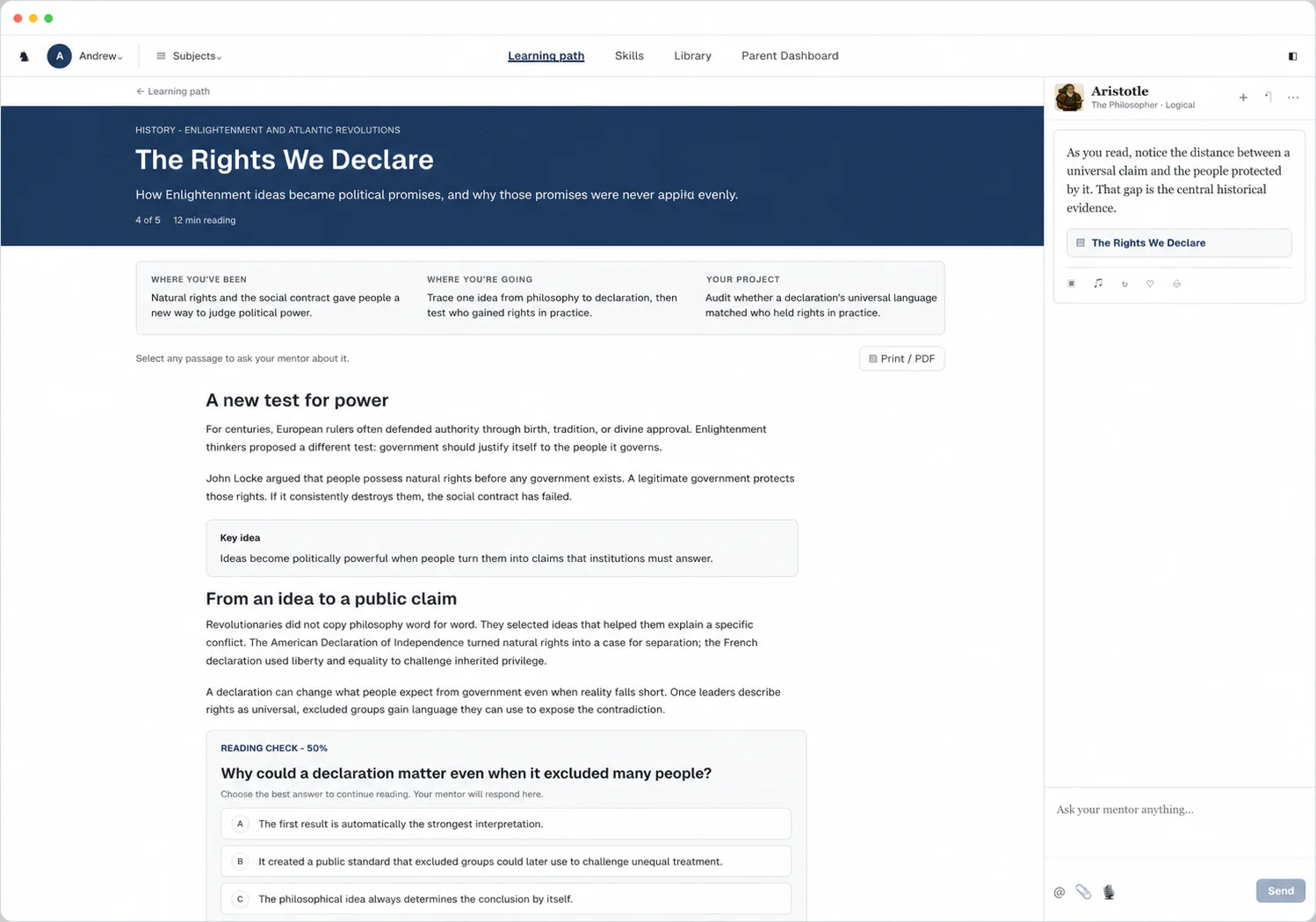
A lesson is an interactive article written for your child, with images and videos made for them and its reading time shown at the top. It opens by saying what your child already knows, where the lesson is going, and which project it leads to.
The article weaves in your child's interests, so a child who loves baseball can meet decimals through batting averages, and the skill stays the point.
An unfamiliar word or confusing paragraph need not end the reading. Your child can highlight it and ask the Always-On Mentor for a pronunciation, explanation, or drawing.
Practice and checking: graded
Progress checks along the way and a reading check at the end show whether each idea has landed. Your child can return to an idea and ask the mentor for another explanation before trying again. During a check, the mentor can clarify the ideas without pointing to the answer.
Each project keeps its criteria beside the work, so your child can see what the task asks for before starting. Revised attempts stay saved with the original, making the changes visible in the course record.
Records: kept as your child works
Our school record builds itself as your child works: the daily check-in and your child's activity build the attendance log, every grade is saved with its feedback, and hours are counted for each subject.
Our Parent Dashboard, your view of each child's day, grades, and records, shows it all, and the document tools draft your state's documents from it, from a letter of intent to quarterly reports.
In high school, the same record becomes credits, at 120 hours a credit, and then a transcript with course grades and a GPA, plus course descriptions and a diploma, ready for your signature.
Which subjects your child takes
School in a Box includes the four core subjects: math, English language arts, science, and history. It runs up to 12 subjects at once, so your child can add electives from our catalog, such as Spanish, computer science, economics, psychology, art, or engineering, or a custom elective on any topic, built with its own readings and projects.
High schoolers can add SAT and ACT prep and 40 advanced courses built on AP frameworks. Single Subject covers one course, such as math for a child who needs to catch up.
Many states list subjects a homeschool must teach, usually reading, writing, math, science, and history or civics, which the core subjects cover. Where a state adds more, such as health or physical education, those are electives in our catalog. Our requirements checker shows your state's list and what you must file.
What children learn at each stage
Each stage builds on the one before, and a child can be at different stages in different subjects.
- Kindergarten to 2nd grade: reading and math carry the year. Our K-2 program, Foundations, teaches sounds, blending, and counting with every step read aloud, and its reading lessons use only words your child can already sound out. See the kindergarten and 2nd grade curriculum pages.
- 3rd to 5th grade: children move from learning to read to reading to learn. Fractions and paragraph writing are the two skills to watch, because a weak foundation shows up there first. See our elementary curriculum.
- 6th to 8th grade: ratios, pre-algebra, arguments supported with evidence, and history from sources. This is also where independent work habits form; by 8th grade, a child can run most of their own day. See middle school.
- 9th to 12th grade: full courses that earn credits and grades on a transcript, built toward college or work. See high school.
Try your child’s actual courses
The 14-day free trial includes lessons written for your child, mentor help, and grading. Your child can finish a first project and use its feedback for a revision before you decide to continue.
The Parent Dashboard keeps that work and feedback together. If a subject feels too easy or too hard, your child can retake its placement without losing completed work.
Frequently asked questions
- Do I need teacher guides or answer keys?
- No. You are not teaching or grading the work, so there is nothing to teach from. From Grade 3, lessons and reading checks can be printed if your child prefers paper.
- Is your curriculum as rigorous as a textbook course?
- A textbook moves on when the chapter ends. Ours moves on when your child shows the skill, and projects ask your child to explain their reasoning, not just pick an answer.
- Can siblings in different grades use it together?
- Yes. Each child has their own placement, path, and mentor, and family pricing lowers the price for each child.
See the curriculum on your child's own work
The trial is the full plan, so every subject your child takes in it is the real course from its first lesson on.
$149/month per child after the trial.