How dual enrollment works for homeschoolers: who can enroll, which states pay tuition, how credit transfers, and how college courses fit beside our lessons.
How dual enrollment works
In dual enrollment, a high school student enrolls at a college, takes its courses beside its regular students, and earns college credit. Three different parties decide three different things. The college decides admission and which courses your teen may take, usually after a placement test. Your state's program, if it has one, decides whether a homeschooler's tuition is paid.
And the college your teen attends after high school decides whether the credit counts toward a degree there.
The grade lands on the college's own transcript, permanently. That is the program's main strength for a homeschooler: an outside instructor's grade sits beside the homeschool transcript and shows admissions offices that your teen can do college work. It also means a poor grade follows your teen, so the first course should be one they are ready for.
Check the full cost in your state
Funding depends on the state program, the college, and the course. Tuition support may have an application deadline separate from college admission, and books, fees, or transport may still be the family’s responsibility.
Our dual-enrollment state view explains eligibility, available funding, and official sources for your state. Check those terms before registering, including any repayment rules for withdrawing from or failing a funded course.
Getting in: admission and placement
Each college runs its own process for high school students, and homeschoolers go through the same one, usually with the parent signing where a school counselor would. Expect an application, a parent consent form, and a placement test or test scores in math and English.
Florida colleges look for college-ready scores on their placement test, the SAT, or the ACT, and Texas colleges apply the state's college-readiness rules or an exemption.
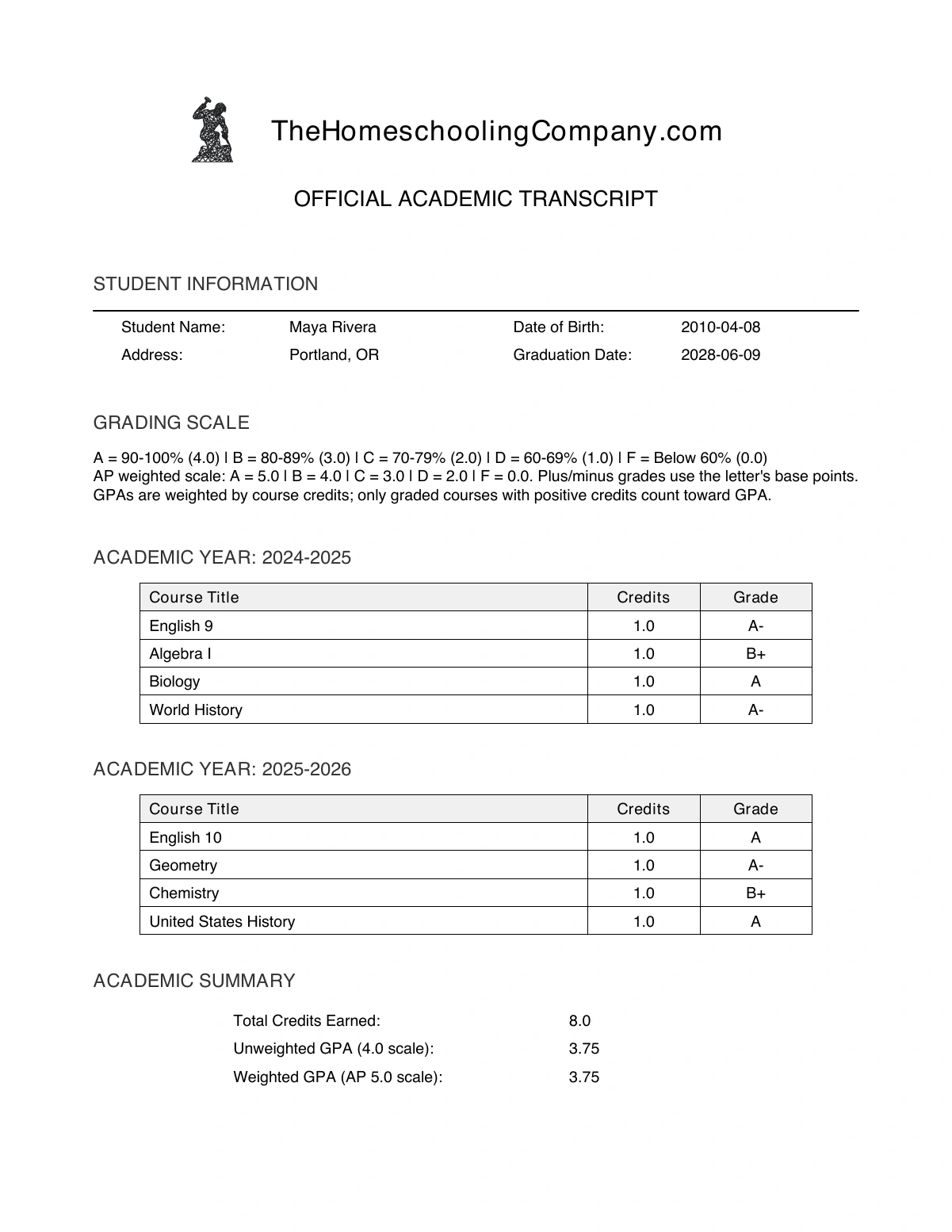
Some colleges also ask for a homeschool transcript. Florida's education department says home education students do not need to provide a transcript or annual evaluation to be eligible, but other colleges do ask. You generate the transcript and course descriptions in the document tools whenever a college wants them.
Will the credit transfer?
Transfer is decided by the college your teen attends later, not the one that taught the course. A college can accept a course for full credit, count it only as an elective, or not count it at all, so check the transfer policy of the colleges your teen is considering before choosing a course.
Two rules protect your teen's record. In Florida, a low grade can suspend dual enrollment under the college's agreement, and in Ohio families may owe repayment for a failed or withdrawn course under the funding rules. So start with one course in a subject your teen is strong in, and add more once the first one goes well.
Fit the other subjects around the college calendar
A college course brings its own deadlines and attendance policy. Your teen can arrange our subjects around those commitments because our lessons have no live class times.
The records stay with the institution that taught each course. Our transcript describes work completed here; the college transcript shows its own course and grade. Keep both for later admission and transfer decisions.
Dual enrollment, AP, or both
Both earn possible college credit, in different ways. A dual enrollment grade is a college grade on a college transcript, earned over a semester. An AP exam score is a single test in May, and each college decides what score earns credit.
Our 40 advanced courses follow the College Board's AP course frameworks, each with practice in the exam's format, so your teen can take an AP subject with us and a different subject at the college in the same year. We do not register students for AP exams; your teen takes the exam at a local school that offers it. Our AP homeschool curriculum page lists every advanced course.
A timeline for the first course
Dual enrollment runs on college calendars, which close earlier than families expect. Counting back from the first college term:
- Two terms ahead: choose the college and the course, and look up your state's funding program and its deadline. Funding windows can close months before the term, as Ohio's does.
- One term ahead: apply to the college as a high school student, sign the parent forms, and take the placement test or send SAT or ACT scores.
- Before the term starts: register for the course, and budget for books and fees, which many funded programs leave to families.
- After the term: request the college transcript, which your teen will send with college applications beside ours.
Frequently asked questions
- Can a 9th or 10th grader dual enroll?
- Sometimes. Ohio's program starts in 7th grade, but many programs, including Minnesota's, Washington's, and North Carolina's, are for juniors and seniors. Colleges may still admit younger students who pass placement.
- Who signs the application for a homeschooled student?
- Usually the parent, who acts as the school. If a college asks for a counselor's signature, ask whether a parent's meets that requirement.
- Does a college course count toward my state's homeschool rules?
- In many states it can. Maryland, for example, accepts a college report card or transcript in place of portfolio materials for that course.
College courses on their schedule, the rest with us
With no live class times, your teen's other subjects fit around any college timetable.
$149/month per child after the trial.
Sources (5)
- Florida Statutes section 1007.271: dual enrollment programs
- Ohio Department of Education and Workforce: College Credit Plus for home-school families
- Washington OSPI: Running Start frequently asked questions
- Georgia Student Finance Commission: Dual Enrollment
- Minnesota Department of Education: Postsecondary Enrollment Options